Buffer Preparation Throughput Metrics That Expose Hidden Delays
Author
Date Published
Reading Time
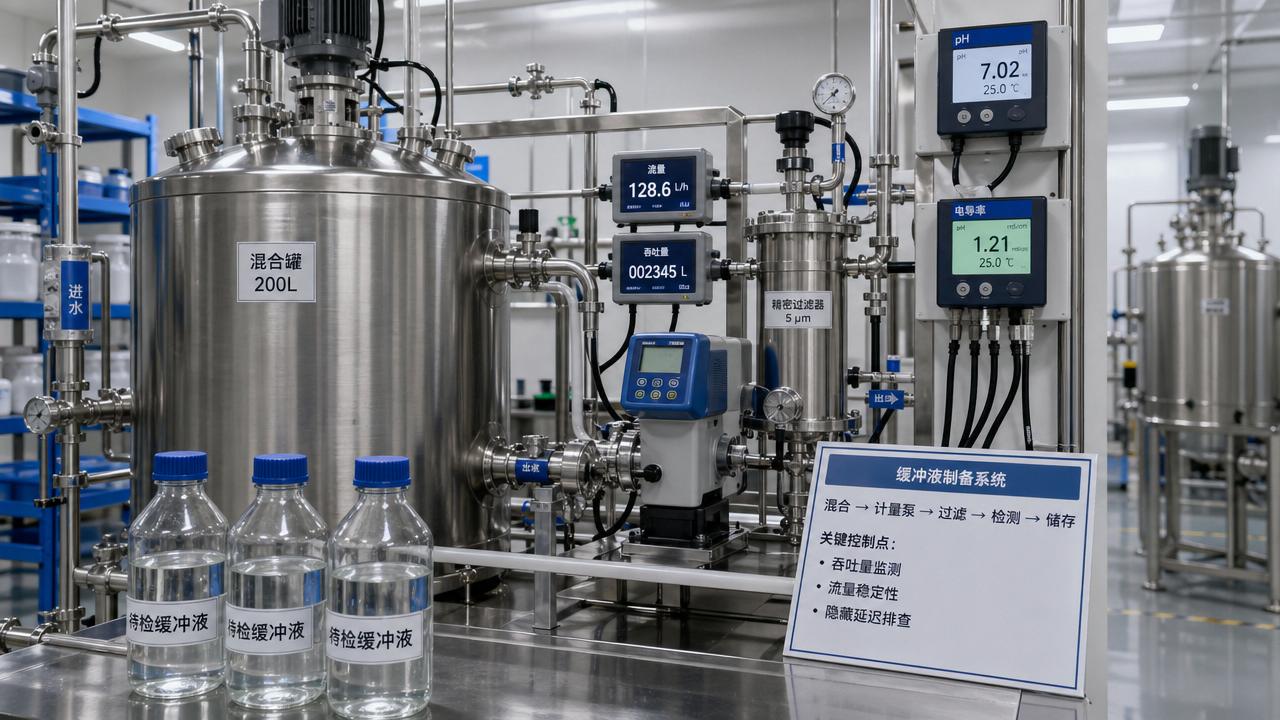
In high-stakes lab and pilot environments, overlooked workflow bottlenecks can quietly erode speed, consistency, and scale-up readiness. By tracking buffer preparation throughput metrics, project managers and engineering leads can uncover hidden delays that affect equipment utilization, batch scheduling, and process reliability. Understanding these indicators is essential for turning fragmented preparation steps into a more predictable, efficient, and production-aligned operation.
Why do buffer preparation throughput metrics matter more than most teams expect?
Buffer preparation is often treated as a supporting activity rather than a critical production constraint. In reality, it sits upstream of bioprocessing, synthesis, purification, cell culture support, and analytical readiness. When preparation steps drift, everything downstream absorbs the delay. For project managers, that means missed milestones, poor resource leveling, and greater risk during technology transfer.
The practical value of buffer preparation throughput metrics is not limited to speed. These metrics expose where labor, vessels, mixing systems, filtration units, automated liquid handling, and hold-time rules interact in ways that reduce actual output. A team may think capacity is constrained by reactor size or batch release timing, when the true bottleneck is in weighing, dissolution, pH adjustment, line clearance, or cleaning turnaround.
- They convert buffer preparation from an invisible utility task into a measurable planning function.
- They reveal hidden delays between nominal cycle time and true productive time.
- They help align lab-scale activity with pilot and pre-production scheduling logic.
- They support procurement decisions for mixers, storage, pumps, sensors, and fluidic precision hardware.
For organizations working across batch-to-continuous transitions or personalized therapeutic workflows, these metrics become even more important. At that point, micro-efficiency is not a nice-to-have. It is the difference between scalable process architecture and recurring operational friction.
Which buffer preparation throughput metrics expose hidden delays first?
Project leaders usually start with total batch time, but that alone is too coarse. To diagnose delay sources, teams need a layered view of throughput. The table below summarizes practical buffer preparation throughput metrics that are useful in mixed lab, pilot, and scale-up settings.
The most useful insight comes from comparing these metrics together rather than in isolation. A site may have acceptable cycle time yet weak right-first-time performance. Another may have high output volume but inefficient labor consumption. Hidden delay usually appears as a mismatch between the metric that management tracks and the operational constraint that technicians live with.
A practical threshold logic for engineering reviews
A simple review structure helps teams avoid data overload. Start by separating delays into three categories:
- Preparation delays caused by material availability, recipe issuance, or operator assignment.
- Process delays caused by mixing inefficiency, slow dissolution, sensor stabilization, or filtration resistance.
- Release delays caused by sampling, documentation review, quality checks, or transfer coordination.
This structure is especially useful when different teams own different parts of the workflow. It keeps the discussion operational instead of political.
Where do hidden delays usually occur in lab and pilot workflows?
In complex facilities, delays are rarely caused by one large failure. They accumulate through small frictions across fluid handling, equipment readiness, operator movement, and data verification. For multidisciplinary environments served by G-LSP, those frictions often sit at the interface between benchtop flexibility and scale-oriented discipline.
Common delay points that throughput metrics bring to light
- Raw material staging takes longer than expected because powders, solvents, or pre-qualified water sources are not positioned near the preparation line.
- Mixing vessels are technically available but not operationally available due to cleaning verification, connection setup, or accessory search time.
- pH and conductivity adjustment requires repeated additions because dosing precision is too coarse for the recipe sensitivity.
- Filtration throughput falls below plan because viscosity, membrane selection, or pump stability was not matched to the formulation.
- Transfer to downstream use is delayed by hose routing, container mismatch, hold-time restrictions, or scheduling conflicts with adjacent unit operations.
These are not merely technical inconveniences. They influence how many runs can be completed in a shift, how often rework occurs, and whether scale-up data reflects real industrial conditions. For project management, that means buffer preparation throughput metrics should be reviewed alongside OEE-style thinking, campaign planning, and deviation trends.
How should project managers interpret buffer preparation throughput metrics for capacity planning?
Capacity planning often fails when nominal equipment ratings are confused with effective output. A 100 L mixing system does not deliver 100 L of useful buffer per planning interval if setup, calibration, adjustment, transfer, and changeover occupy a large share of the shift. The better question is not “What is the vessel size?” but “What is the reproducible throughput under actual operating conditions?”
The following comparison table helps engineering leads judge whether observed delays are primarily labor-driven, equipment-driven, or process-control-driven.
This interpretation model helps prevent overbuying. Many teams respond to delay by purchasing larger equipment, when the actual need is improved fluidic precision, faster changeover architecture, or better synchronization between preparation and consumption points.
How G-LSP supports better capacity judgment
G-LSP’s value for decision-makers lies in cross-pillar benchmarking. Buffer preparation does not depend on one device category alone. It depends on how reactors or mixers, microfluidic control elements, bioprocess infrastructure, separation technologies, and automated liquid handling systems perform together under standards-conscious conditions. That integrated perspective is critical when a project must move from development scale to a production-aligned architecture without losing consistency.
What should procurement and engineering teams evaluate before selecting equipment?
Procurement cannot evaluate buffer systems on vessel volume and price alone. The right selection depends on recipe variability, throughput targets, cleaning philosophy, dosing sensitivity, compliance expectations, and future scale direction. Buffer preparation throughput metrics should therefore be translated into selection criteria before RFQs are issued.
Selection checklist for throughput-focused buying decisions
- Confirm the expected volume range per batch and per day, not just maximum vessel capacity.
- Assess how quickly the system reaches dissolution and uniformity for the specific buffer family.
- Review dosing and measurement precision for pH, conductivity, and concentration-sensitive recipes.
- Compare cleaning turnaround, dead-leg risk, hose complexity, and accessibility of wetted surfaces.
- Check compatibility with single-use or reusable components based on validation strategy and campaign frequency.
- Verify documentation support for ISO-, USP-, and GMP-aligned environments where applicable.
When teams document these requirements early, they reduce the chance of buying a technically acceptable but operationally unsuitable system. That is especially important for engineering project leads who must defend capex decisions under schedule pressure.
How do standards and compliance affect throughput in real operations?
Compliance is sometimes treated as separate from throughput, but in regulated and quality-sensitive environments the two are closely linked. If documentation, traceability, calibration, material compatibility, and cleaning verification are weak, cycle time rises through investigation, rework, and approval delay. Strong throughput is therefore not just fast movement of liquid. It is controlled movement with defensible records.
For organizations working near pharmaceutical, chemical, and advanced lab-production boundaries, buffer preparation throughput metrics should be reviewed together with:
- Calibration discipline for pH, conductivity, flow, and weight measurement points.
- Material traceability for contact parts, tubing, and single-use assemblies.
- Cleaning validation logic or documented changeover control where reusable hardware is involved.
- Recipe governance and version control to reduce operator interpretation gaps.
This is where technical benchmarking becomes especially valuable. G-LSP helps teams compare systems not only by nominal performance, but also by their readiness for audited, repeatable, and scale-conscious operation.
Common misconceptions about buffer preparation throughput metrics
“If the batch finishes today, throughput is fine.”
Finishing a batch does not mean the process is efficient. If it required overtime, rework, or schedule displacement, the system is masking low throughput behind human effort.
“A bigger tank will solve the delay.”
Not necessarily. If the delay is in setup, adjustment precision, filtration, or release approval, larger volume may increase hold risk without improving effective output.
“Automation always improves throughput.”
Automation helps when matched to the actual bottleneck. If the process is limited by material staging or QC release timing, adding automation to mixing alone may not change the full-cycle result.
“Lab data directly predicts pilot performance.”
Only if fluidic behavior, dosing control, changeover logic, and equipment architecture scale in a comparable way. Otherwise, buffer preparation throughput metrics measured at bench level can be misleading.
FAQ: what do project managers ask most often?
How often should buffer preparation throughput metrics be reviewed?
For active projects, review them at least weekly during process development and daily during critical scale-up windows or campaign execution. Monthly review is usually too slow to catch recurring hidden delays before they affect milestones.
Which metric should be prioritized first?
Start with full preparation cycle time, right-first-time batch rate, and changeover time. Together, these three show whether the issue is speed, precision, or turnaround. After that, add labor normalization and release delay tracking.
Are buffer preparation throughput metrics useful outside biopharma?
Yes. Chemical R&D, formulation labs, pilot synthesis, specialty materials processing, and precision fluid handling environments all benefit from the same logic. Any workflow that depends on repeatable solution preparation can use these metrics to uncover hidden scheduling and quality losses.
What is the biggest implementation mistake?
Measuring only equipment run time and ignoring staging, adjustments, sampling, and release. That approach underestimates true delay and often leads to poor capital decisions.
Why choose us for throughput benchmarking and decision support?
G-LSP is built for organizations that cannot afford guesswork between lab success and industrial execution. Our multidisciplinary benchmarking approach links fluidic precision, bioconsistent hardware behavior, scale-aware engineering logic, and standards-oriented evaluation across five industrial pillars. That means project managers and engineering leads can assess buffer preparation throughput metrics in the context that actually matters: end-to-end operational readiness.
You can contact us for specific, decision-ready support on:
- Parameter confirmation for mixing, dosing, transfer, and filtration workflows.
- Equipment and system selection for lab, pilot, or production-aligned preparation environments.
- Delivery cycle discussions for critical project timelines and phased implementation plans.
- Custom solution evaluation for fluidic precision, single-use integration, or automation architecture.
- Standards and documentation expectations relevant to ISO, USP, and GMP-facing workflows.
- Quotation alignment based on throughput targets, operational constraints, and future scale-up intent.
If your team is seeing unexplained scheduling drift, low effective output, or repeated preparation rework, a focused review of buffer preparation throughput metrics is often the fastest way to identify what is truly slowing the operation. The earlier those delays are made visible, the easier it becomes to protect capacity, quality, and project delivery confidence.
Expert Insights

Chief Security Architect
Dr. Thorne specializes in the intersection of structural engineering and digital resilience. He has advised three G7 governments on industrial infrastructure security.
Related Analysis
Core Sector // 01
Security & Safety
- Dial Indicators in Bulk: Accuracy Grades, Mounting Styles, and Supplier ChecksAuthor :Lina Cloud

- Why hydraulic hoses bulk orders fail pressure checks?Author :Lina Cloud

- How to Vet a Titration System OEM Supplier Before Scale-UpAuthor :Lina Cloud

- Titration Accuracy and Sensitivity Data That Actually MatterAuthor :Lina Cloud

- Choosing a Peristaltic Pump for Lab Wholesale Without OverbuyingAuthor :Lina Cloud

- How Much Titration Accuracy Is Enough for Routine QC Work?Author :Lina Cloud

- Why automated buffer preparation factory output can vary by batchAuthor :Lina Cloud

- When Dilution Factor Precision Starts Affecting Final ResultsAuthor :Lina Cloud