ACE HTS Checks Raise Import Compliance Risk
Author
Date Published
Reading Time
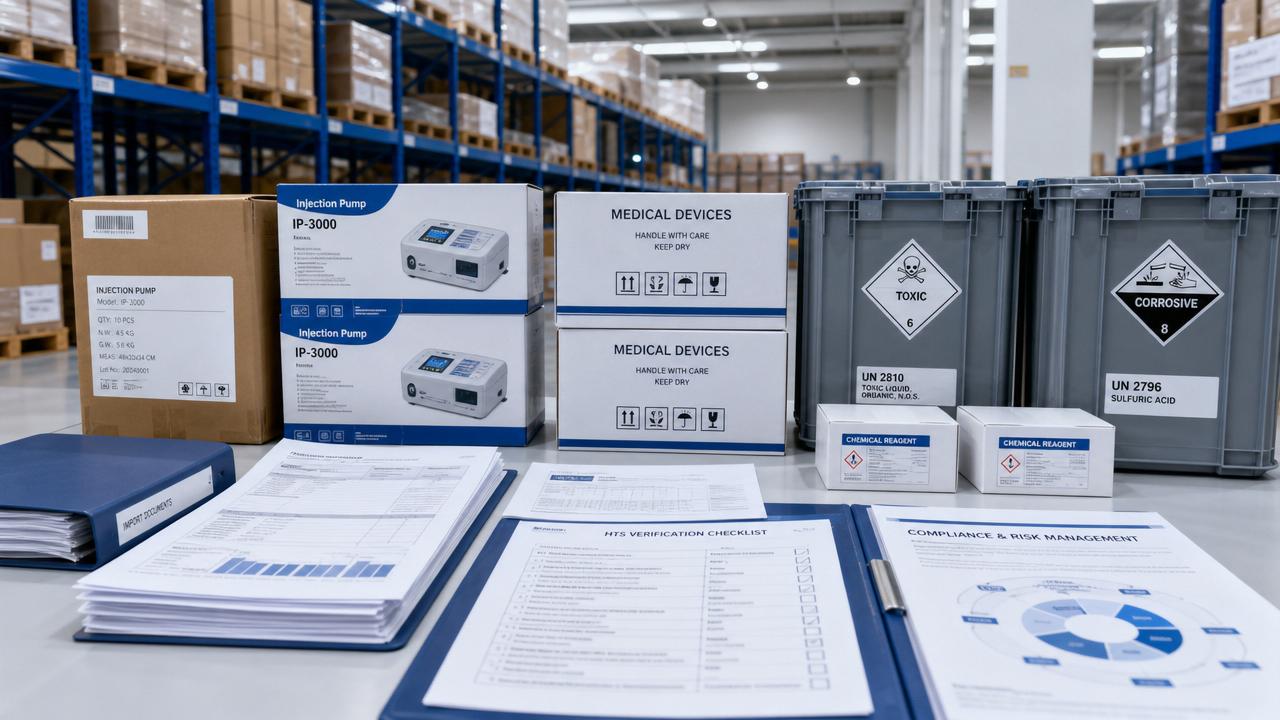
From June 2, 2026, U.S. Customs and Border Protection will activate the F865 error code in the ACE system to enforce matching checks across HTS codes, importer qualifications, industry registrations, and operating licenses. The change deserves close attention from companies involved in syringe pumps, medical devices, chemicals, and other sensitive product categories because mismatched information may lead to automatic rejection of import declarations without a correction channel.
Event Overview
U.S. Customs and Border Protection has announced that, starting June 2, 2026, the ACE system will enable the F865 error code. The rule requires four-way validation among the declared HTS code, importer qualification, industry filing, and operating license.
According to the available information, high-sensitivity categories such as syringe pumps, medical devices, and chemical products will be automatically rejected if the relevant declaration information does not match. The announced mechanism does not provide a post-rejection correction channel.
The publicly available information indicates that this change will raise the compliance threshold for U.S. imports and affect customs clearance certainty for global buyers and related supply chain participants.
Which Segments May Be Affected
Direct Import and Trading Companies
Direct importers and trading companies are likely to face the most immediate operational impact because the ACE system validation is tied directly to import declaration data. If the HTS code, importer status, filing information, or operating license does not align, the declaration may be rejected automatically.
From an industry perspective, the main impact will appear in the reliability of customs clearance. Companies that handle syringe pumps, medical devices, or chemical products may need to place greater emphasis on declaration consistency before goods enter the import process.
Procurement Companies and Global Buyers
Procurement companies and global buyers may be affected because customs clearance uncertainty can influence purchasing schedules and delivery commitments. Even when the goods themselves are ready for shipment, inconsistent declaration-related information may interrupt the import process.
Analysis shows that the key issue for buyers is not only whether a product can be sourced, but whether the supplier, importer, and declared category information can support a compliant entry into the U.S. market under the ACE validation framework.
Manufacturing and Export-Oriented Suppliers
Manufacturers and export-oriented suppliers that serve U.S. buyers may not submit ACE declarations directly, but their product classification information and documentation can affect import outcomes. Products such as syringe pumps and other medical device categories may require closer alignment between product descriptions, HTS codes, and buyer-side compliance records.
Observably, the impact on manufacturers is likely to appear through customer documentation requests, pre-shipment verification, and closer scrutiny of product classification before purchase orders are finalized.
Medical Device and Chemical Product Businesses
Medical device and chemical product businesses are specifically relevant because the announced information identifies these as high-sensitivity categories. For these companies, the risk is concentrated in whether the declared HTS code and required business qualifications match the importer’s filings and licenses.
What deserves closer attention now is the link between product category sensitivity and declaration acceptance. A mismatch in any of the four checked elements may create a direct barrier at the customs declaration stage.
Supply Chain and Customs Service Providers
Supply chain service providers, freight forwarders, and customs-related service teams may face higher requirements for pre-declaration checks. Since the F865 error code is designed to trigger rejection when information is inconsistent, service providers may need to confirm data accuracy earlier in the process.
From an industry perspective, the role of these providers may shift from document handling to stronger compliance coordination among importers, suppliers, and buyers.
What Companies Should Watch and How to Respond
Track Official Updates and Implementation Details
Companies should continue monitoring U.S. Customs and Border Protection communications regarding the ACE F865 error code and related enforcement details. The current information confirms the activation date and the four-way matching requirement, while practical implementation outcomes may still need to be observed after the rule takes effect.
Review High-Risk Product Categories Before Declaration
Businesses dealing with syringe pumps, medical devices, and chemical products should review whether the HTS code, importer qualification, industry registration, and operating license are consistent before submitting import declarations. This is particularly important because the announced mechanism indicates automatic rejection where mismatches occur.
Align Supplier, Buyer, and Importer Documentation
Companies should ensure that product classification information and importer-side qualifications are reviewed together rather than separately. For global buyers, this means confirming that suppliers provide classification-related documentation that can be reconciled with the importer’s declared status and licensing information.
Prepare Operational Contingency Plans
Because the announced rejection mechanism does not include a correction channel, affected companies should prepare practical contingency plans for shipment timing, customer communication, and alternative handling if a declaration fails. These plans should be tied directly to the affected product categories and U.S. import procedures rather than general business management measures.
Editorial View / Industry Observation
Analysis shows that the ACE F865 activation is more than a technical system update. It is more appropriate to understand this as a compliance signal that places greater weight on the consistency of customs classification, importer qualification, industry filing, and licensing information.
At the same time, it should not be overstated beyond the available information. The confirmed change is the activation of a validation mechanism from June 2, 2026. The actual scale of business disruption, rejection frequency, and follow-up handling practices will need continued observation after implementation.
From an industry perspective, the most important point is that customs clearance certainty may become more dependent on upstream preparation. Companies involved in high-sensitivity categories should treat declaration data consistency as a practical import risk control issue.
Conclusion
The activation of the F865 error code in the U.S. ACE system marks a higher compliance threshold for imports involving HTS codes, importer qualifications, industry filings, and operating licenses. For syringe pumps, medical devices, chemicals, and related supply chain participants, the issue is not only regulatory awareness but the operational ability to prevent mismatches before declaration.
It is more appropriate to understand this development as both an immediate compliance requirement and a signal of tighter declaration scrutiny. Companies should respond with targeted document review, category-specific verification, and continued monitoring of official implementation details.
Information Source Statement
Main source: U.S. Customs and Border Protection announcement information provided in the event brief.
Items requiring continued observation: actual implementation of the F865 error code in ACE after June 2, 2026; practical rejection handling for affected declarations; and any subsequent official clarification concerning HTS code validation, importer qualification matching, industry filing, and operating license requirements.
Expert Insights

Chief Security Architect
Dr. Thorne specializes in the intersection of structural engineering and digital resilience. He has advised three G7 governments on industrial infrastructure security.
Related Analysis
Core Sector // 01
Security & Safety
- Precision Dispenser Pricing: Cost Drivers and Budgeting for Lab AutomationAuthor :Dr. Aris Nano

- China Tightens Export Compliance Checks on Lab Fluid-Control DevicesAuthor :Dr. Aris Nano

- China Tightens Export Checks on Lab Fluid DevicesAuthor :Dr. Aris Nano

- China Customs Tightens Export Checks for Lab Liquid-Handling EquipmentAuthor :Dr. Aris Nano

- ECHA SVHC Update Reaches Precision Fluid DevicesAuthor :Dr. Aris Nano

- FDA Tightens Accuracy Rule for Lab Fluid DevicesAuthor :Dr. Aris Nano

- ECHA Adds 12 SVHCs Affecting Lab Fluid DevicesAuthor :Dr. Aris Nano

- How to Choose a Variable Speed Peristaltic Pump for Accurate Lab Fluid TransferAuthor :Dr. Aris Nano