CAICT Releases 2026 White Paper on Export Compliance for High-Precision Fluid Control Devices
Author
Date Published
Reading Time

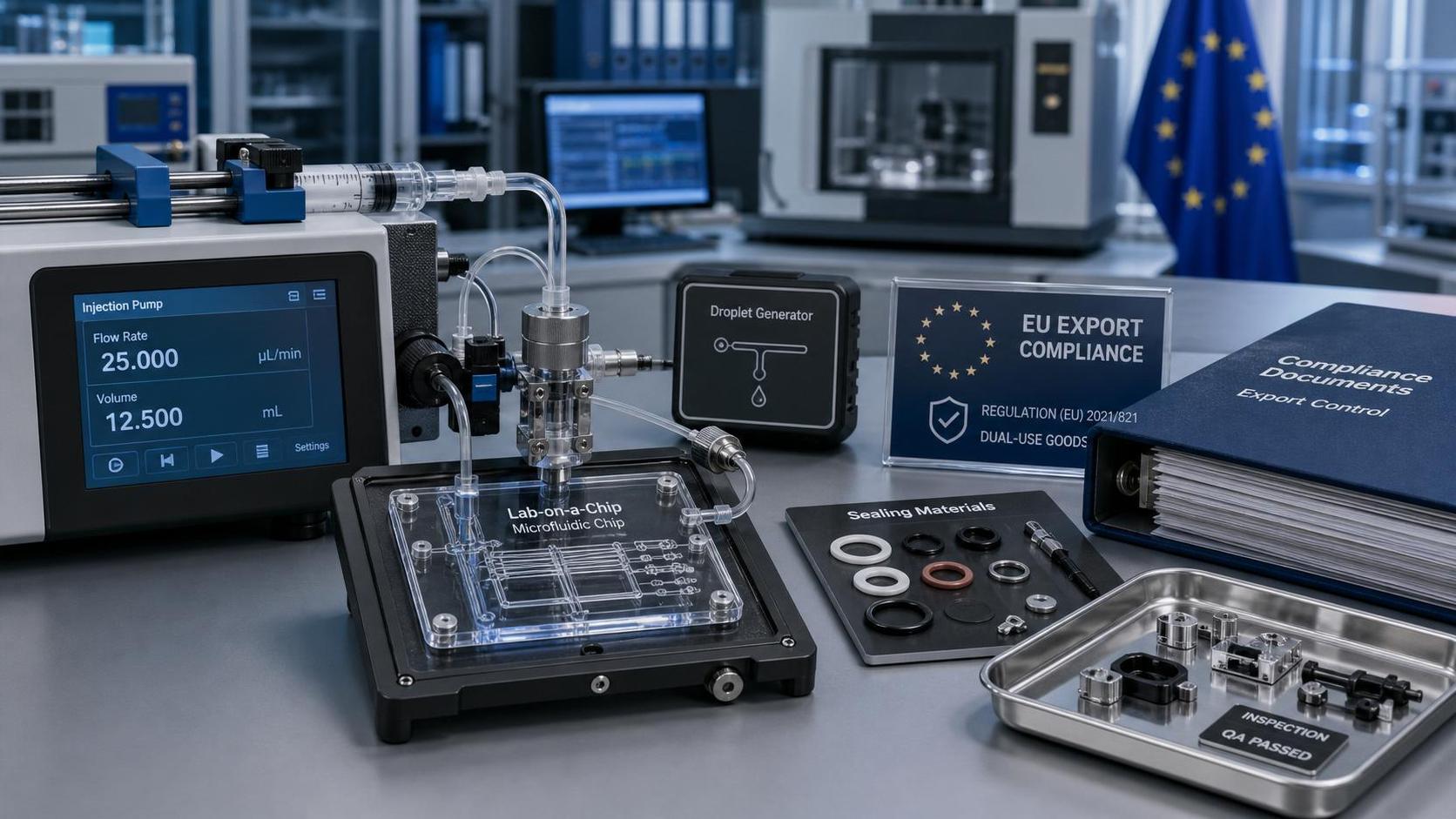
On May 13, 2026, the China Academy of Information and Communications Technology (CAICT) released the White Paper on Export Compliance for High-Precision Fluid Control Devices (2026), identifying syringe pumps as a key monitored category. The publication signals heightened regulatory scrutiny—particularly from U.S. and EU export control regimes—on devices integrating AI algorithms and wireless communication modules. Medical device manufacturers, life sciences instrumentation exporters, and industrial fluid handling solution providers should closely monitor implications for cross-border supply chains, algorithm governance, and dual-use compliance.
Event Overview
On May 13, 2026, CAICT published the White Paper on Export Compliance for High-Precision Fluid Control Devices (2026). The document states that syringe pumps have been designated a priority monitoring category due to their integration of AI algorithms and wireless communication modules, rendering them newly subject to U.S. Export Administration Regulations (EAR) and EU Dual-Use Regulation. According to the white paper, China’s syringe pump exports to Russia, Iran, and Venezuela declined by 37% in Q4 2025, primarily attributed to newly introduced algorithm-level review requirements under those regulations. The white paper recommends enterprises establish export algorithm registration systems and hardware–software decoupling mechanisms.
Industries Affected
Direct Exporters of Fluid Control Equipment
Companies exporting syringe pumps—and similar high-precision fluid control devices—face increased pre-shipment compliance obligations. The inclusion of AI logic and wireless connectivity now triggers mandatory algorithm disclosure and classification assessments under EAR and EU dual-use rules, potentially delaying shipments or requiring license applications for previously exempted configurations.
Medical Device OEMs and System Integrators
OEMs embedding syringe pumps into larger diagnostic, analytical, or therapeutic platforms may inherit export classification responsibilities. If the final integrated system incorporates AI-driven flow control or remote telemetry features, the entire product may fall under stricter controls—even if the pump itself is commercially off-the-shelf.
Suppliers of Embedded Components and Modules
Component suppliers providing AI inference chips, BLE/Wi-Fi modules, or firmware with adaptive control logic may find their products reclassified when deployed in regulated fluid control applications. Downstream customers’ use cases—not just technical specifications—now influence export jurisdiction, increasing traceability and documentation demands across the bill of materials.
Key Considerations and Recommended Actions for Enterprises
Monitor official updates to EAR Supplement No. 4 and EU Council Regulation (EU) 2021/821 Annex I revisions
The white paper cites algorithm-level review as a driver of recent export declines. Enterprises should track formal amendments to U.S. and EU control lists—especially new entries related to ‘adaptive fluid delivery control’ or ‘AI-enabled precision dosing systems’—as these may expand licensing requirements beyond current scope.
Review and document AI functionality at the firmware and software layer for all exported syringe pump models
Per CAICT’s recommendation, companies should initiate internal algorithm inventory and classification exercises. This includes mapping training data sources, inference logic boundaries, and update mechanisms—distinct from general software documentation—to support potential export registration or license application submissions.
Assess feasibility of hardware–software decoupling for export-targeted configurations
The white paper explicitly proposes hardware–software decoupling as a mitigation strategy. Firms should evaluate whether AI or wireless features can be disabled, omitted, or delivered post-export via secure, auditable channels—without compromising core fluid control performance or certification status.
Update internal export compliance checklists to include end-user destination risk screening for non-Wassenaar jurisdictions
The 37% export decline cited occurred specifically in shipments to Russia, Iran, and Venezuela—jurisdictions subject to comprehensive sanctions. Companies should reinforce destination-based red-flag protocols, especially where distributors or integrators serve end users in high-risk markets, even if the immediate consignee appears low-risk.
Editorial Perspective / Industry Observation
Observably, this white paper functions less as an enforcement instrument and more as a forward-looking risk signaling mechanism. It does not introduce new Chinese export controls but synthesizes emerging foreign regulatory trends—particularly the expansion of dual-use criteria to embedded algorithmic behavior—into actionable guidance for domestic exporters. Analysis shows that the focus on ‘algorithm-level review’ reflects a broader shift in Western export policy: from hardware-centric controls toward functional and architectural assessments. From an industry perspective, the white paper underscores that compliance is no longer determined solely by physical specs (e.g., flow rate accuracy), but also by how intelligence is implemented and communicated within the device. Current developments are better understood as a calibration phase—where regulators test implementation pathways—rather than a finalized control regime.
This is not yet a binding mandate from Chinese authorities, nor does it reflect unilateral Chinese restrictions. Rather, it serves as a structured interpretation of external regulatory pressure points, aimed at aligning domestic industry practices with anticipated international compliance expectations.
Current developments are best interpreted as a preparatory signal—not an operational disruption—indicating that algorithm transparency and modular architecture will increasingly define export eligibility for intelligent fluid control equipment.
Conclusion
The CAICT white paper marks a formal recognition that AI-integrated syringe pumps are entering a higher tier of global export scrutiny—not because of inherent military utility, but due to evolving interpretations of dual-use functionality. Its primary significance lies in clarifying how foreign regulatory logic is being translated into domestic readiness guidance. For affected enterprises, the priority is not immediate restructuring, but systematic alignment of product documentation, firmware governance, and supply chain visibility with emerging algorithm-aware compliance frameworks. This remains a horizon-scanning exercise, not a crisis response—but one demanding deliberate, documented preparation.
Source Attribution
Main source: China Academy of Information and Communications Technology (CAICT), White Paper on Export Compliance for High-Precision Fluid Control Devices (2026), published May 13, 2026.
Points requiring ongoing observation: Formal updates to U.S. EAR Supplement No. 4 and EU Dual-Use Regulation Annex I; implementation timelines for algorithm registration mechanisms in Chinese export licensing procedures; sector-specific guidance from MIIT or MOFCOM on hardware–software decoupling standards.
Expert Insights

Chief Security Architect
Dr. Thorne specializes in the intersection of structural engineering and digital resilience. He has advised three G7 governments on industrial infrastructure security.
Related Analysis
Core Sector // 01
Security & Safety
- Precision Dispenser Pricing: Cost Drivers and Budgeting for Lab AutomationAuthor :Dr. Aris Nano

- China Tightens Export Compliance Checks on Lab Fluid-Control DevicesAuthor :Dr. Aris Nano

- China Tightens Export Checks on Lab Fluid DevicesAuthor :Dr. Aris Nano

- China Customs Tightens Export Checks for Lab Liquid-Handling EquipmentAuthor :Dr. Aris Nano

- ECHA SVHC Update Reaches Precision Fluid DevicesAuthor :Dr. Aris Nano

- FDA Tightens Accuracy Rule for Lab Fluid DevicesAuthor :Dr. Aris Nano

- ECHA Adds 12 SVHCs Affecting Lab Fluid DevicesAuthor :Dr. Aris Nano

- How to Choose a Variable Speed Peristaltic Pump for Accurate Lab Fluid TransferAuthor :Dr. Aris Nano