Automated Buffer Preparation: Troubleshooting pH and Conductivity Drift
Author
Date Published
Reading Time
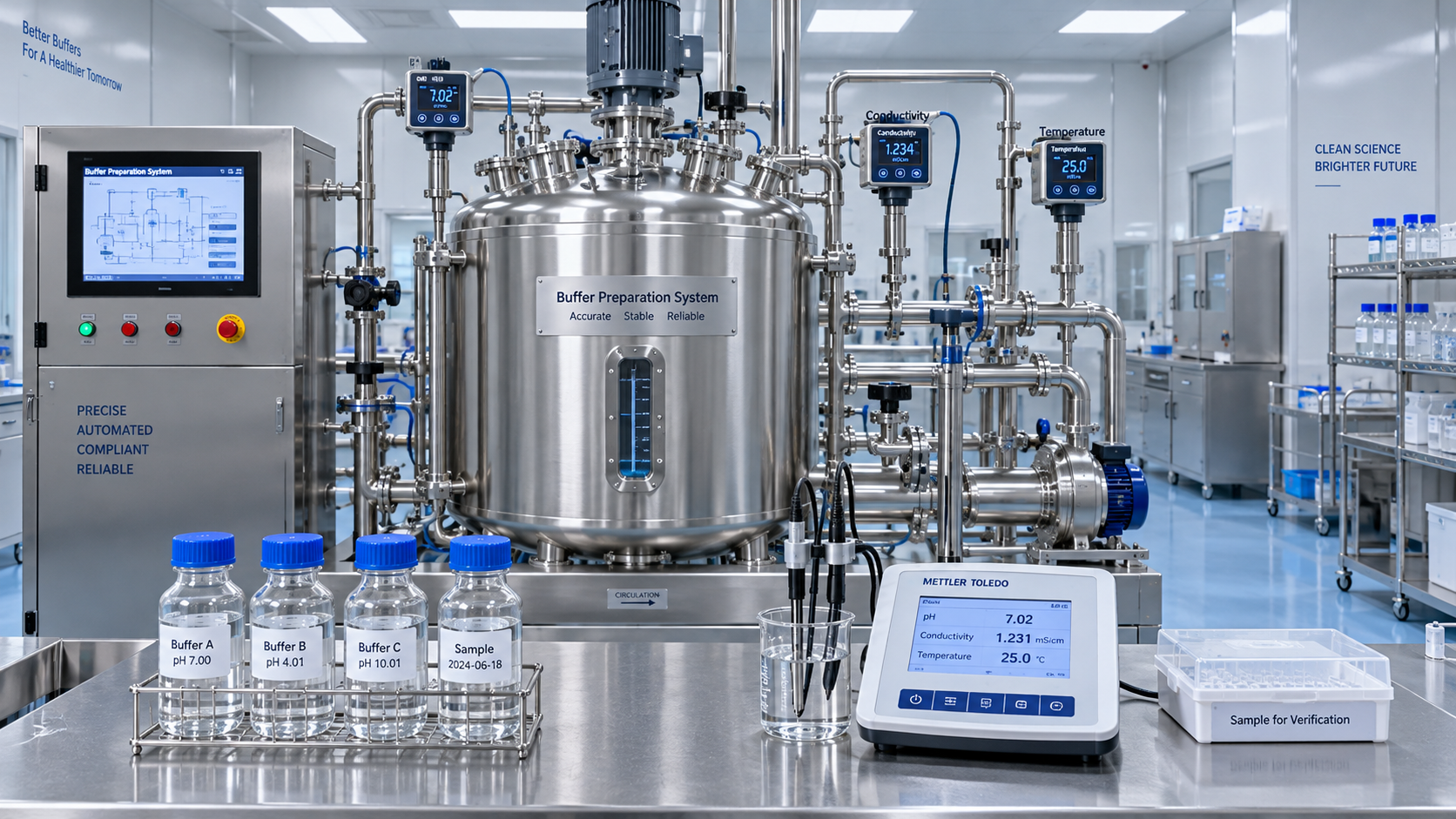
Unexpected pH or conductivity drift in automated buffer preparation does not automatically mean the recipe is wrong. A changing reading can come from temperature, incomplete mixing, sensor instability, or inconsistent delivery—even when the intended ingredients are correct. Adding acid, base, or salt before separating these causes can turn a measurement problem into a genuine formulation failure.
The decisive check is whether a representative, equilibrated sample confirms the in-line result under comparable measurement conditions. If it does not, investigate the measurement chain and sampling location. If it does, trace the batch composition and dosing history before changing the recipe.
Stop corrective dosing before it obscures the cause
When a result moves outside the approved operating range, place the batch in the appropriate hold state and follow the established deviation procedure. Where the process permits, pause corrective additions while maintaining the specified mixing or recirculation. Do not disable interlocks or continue feeding an affected buffer downstream simply because the displayed value briefly returns to target.
Preserve the information available before any intervention:
- Raw pH, conductivity, and temperature trends—not just the final reported values.
- Dosing commands, delivered-volume or mass records, valve states, and pump alarms.
- Mixing speed, recirculation flow, vessel level, and the timing of each addition.
- Stock identities, concentrations, lot numbers, and preparation records.
- Sensor calibration, cleaning, replacement, and maintenance history.
The timing of the deviation is particularly useful. A reading that changes during warm-up suggests a different investigation from one that jumps immediately after a concentrate addition. A stable offset from the beginning points toward calibration, stock composition, or recipe configuration; repeated overshoot after correction points toward measurement delay or dosing behavior.
Establish whether the drift is real
Take a sample using the approved sampling procedure after the specified mixing period. Avoid sampling beside a concentrate inlet or from an unflushed dead leg. Record the sampling time and temperature so the laboratory result can be compared with the corresponding in-line reading rather than with a later point on the trend.
Use an independently verified instrument. Comparing two probes that share an unsuitable calibration standard or incorrect compensation setting does not provide meaningful confirmation. Check pH with appropriate fresh calibration buffers that bracket the expected measurement range, and verify conductivity with a suitable standard for the working range.
Bring the sample and reference measurement to the recipe’s specified measurement conditions. Minimize unnecessary exposure to air, especially for dilute or weakly buffered solutions. Carbon dioxide uptake can change pH after collection, making a delayed open-container measurement an unreliable representation of the vessel.
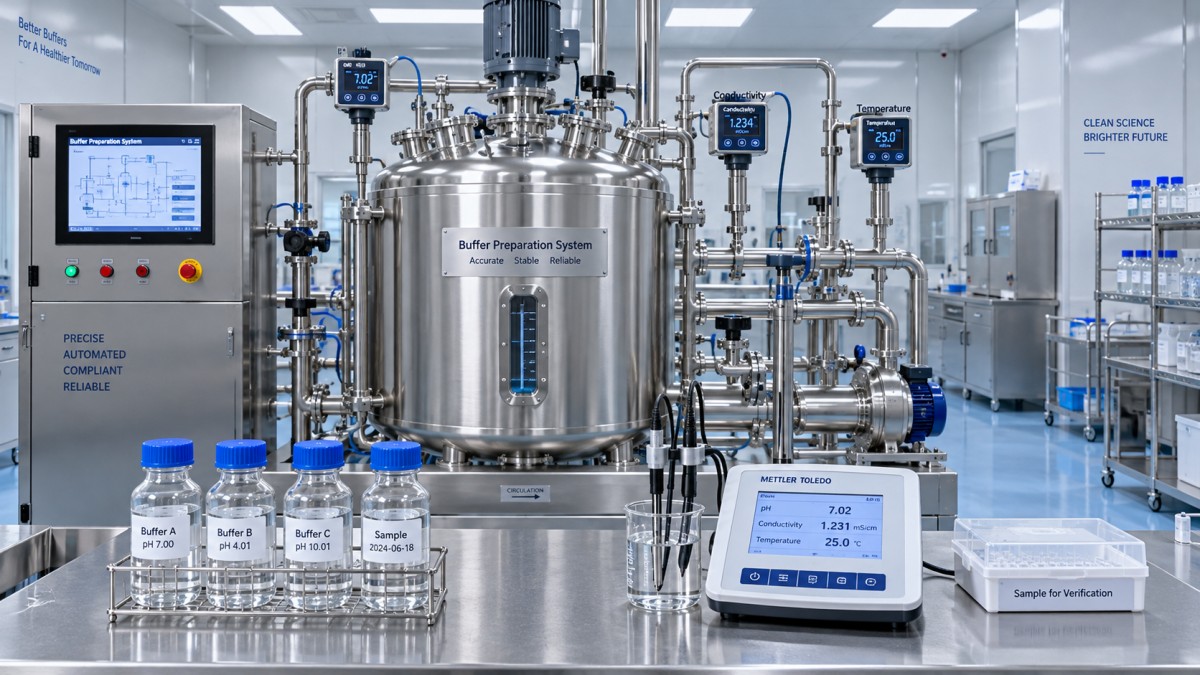
These patterns identify where to investigate; they are not proof of a single cause. For example, temperature changes and incomplete mixing can occur together after a cold concentrate enters a warmer vessel.
Separate temperature effects from sensor faults
For pH, automatic temperature compensation adjusts the electrode response to temperature. It does not generally convert the solution’s chemistry to the pH it would have at a different temperature. Buffer pH itself can change with temperature, and that relationship depends on composition. Two correctly functioning instruments can therefore disagree if they measure the same buffer at different temperatures.
Conductivity requires a separate check. Ion mobility changes with temperature, so instruments may display conductivity normalized to a reference temperature. The result depends on the compensation model. A coefficient suitable for one solution is not necessarily suitable for another buffer or concentration range.
Compare the temperature reading, reference temperature, compensation method, and displayed units on both instruments. Confirm whether each result is raw or temperature-compensated. A mismatch between conductivity and specific conductance reporting can appear to be process drift when the underlying measurement is consistent.
Also inspect the temperature sensor’s position and response. If the conductivity cell sees a newly added cold stream while the temperature element responds more slowly, compensation can temporarily distort the displayed result. Stable measurements after thermal equilibration help distinguish this transient from an actual concentration error.
Check the sensing surface and installation
A pH electrode can pass calibration yet respond poorly in the process. A fouled glass surface, restricted reference junction, aged electrode, or unsuitable storage history can cause slow response or unstable readings. Review calibration slope and offset against the manufacturer’s and site’s acceptance criteria, but also examine how quickly the probe stabilizes in a representative solution.
Low-conductivity solutions deserve particular attention because pH measurement can be sensitive to junction behavior, electrical interference, and flow conditions. A probe suitable for a concentrated buffer may not perform equally well in a highly dilute formulation.
For conductivity, verify the cell constant, measurement range, and configuration. Deposits can alter the response; trapped gas can reduce effective liquid contact and create unstable or biased readings. Inspect the installation for incomplete immersion, air accumulation, and intermittent wetting during low-level operation. Apply cleaning procedures appropriate to the sensor materials and process residues.
Check cables, connectors, grounding, and electrical isolation where readings change with pump or mixer operation. A signal that shifts when a motor starts, without an independent sample change, warrants investigation of the electrical installation. Avoid treating such a shift as a chemical dosing requirement.
After cleaning, calibration, or replacement, verify performance with an independent measurement. An improved-looking trend alone is not sufficient evidence that the fault has been resolved.
Distinguish a mixed batch from a locally correct reading
The probe measures its immediate surroundings, not the vessel average. If a dosing inlet is close to the sensor, a small acid or base addition can produce a large local pH excursion before it disperses. The controller may then add the opposite reagent, creating oscillation and increasing dissolved-ion content without improving batch consistency.
Recirculation introduces another delay: material must travel from the addition point through the loop before the sensor detects the change. Filters, tubing, flow rate, and vessel volume all affect that delay. A control loop tuned for one configuration may become unstable after a tubing change or at a different batch size.
Review impeller immersion, mixer operation, return-line position, and actual recirculation flow. Visible surface motion is not proof that the entire vessel is mixed. Excessive agitation can also entrain air and disturb the sensors, so increasing speed without checking the approved operating conditions is not a universal remedy.
Where permitted, compare samples from representative locations after a defined mixing interval. Persistent location-dependent differences support a mixing problem. Agreement between locations, combined with unstable in-line readings, redirects attention toward the sensor or flow cell.
Corrective dosing must respect the time needed for transport, mixing, and sensor stabilization. Any change to dose size, correction limits, controller gain, or waiting time should follow approved change control rather than being improvised during a production batch.
Trace composition errors through the delivery system
If independent measurements confirm the deviation, reconcile what entered the vessel. A correct programmed quantity does not establish that the correct quantity was delivered. Depending on the equipment, air in suction lines, incomplete priming, worn pump tubing, backpressure changes, leaking valves, or siphoning can cause delivery errors.
Check connections and stock identity before recalibrating pumps. Swapped lines or incorrectly assigned recipe channels can deliver plausible volumes of the wrong solution. Verify concentration, salt form, hydrate form where relevant, dissolution status, and the basis used for preparation—such as final solution volume rather than water volume alone.
Use an approved delivery-verification method under representative operating conditions. Gravimetric checks can provide useful evidence, but converting mass to volume requires the correct solution density at the relevant temperature. Water-based pump calibration may not establish accuracy for a more viscous concentrate.
Reconcile total batch mass or volume as well as individual additions. Conductivity can indicate an overall dilution error, but it is not a universal assay of buffer concentration. Different ionic compositions can produce similar conductivity, and an incorrect acid-to-base ratio can shift pH without a proportionate conductivity change.
Interpret the two measurements together:
- Conductivity is high while pH is acceptable: investigate excess concentrate, insufficient dilution water, salt carryover, or accumulated correction reagents.
- Conductivity is low while pH is acceptable: investigate over-dilution or under-delivery of components. The pH may remain acceptable because the acid-to-base ratio is preserved.
- pH is incorrect while conductivity is close to target: investigate component ratio, acid or base strength, stock identity, and pH measurement integrity.
- Both values are incorrect: review the full formulation and delivery balance rather than assuming one correction will resolve both.
Conductivity should not be “corrected” by adding salt unless the formulation explicitly permits it. Likewise, reaching the pH target through repeated acid and base additions can leave an unacceptable ionic composition.
Investigate drift that continues after preparation
A buffer that passes immediately after mixing but changes during holding requires a time-based investigation. Compare measurements at consistent temperature and defined hold intervals. Examine whether the vessel is open or closed, whether evaporation is credible under the holding conditions, and whether gas exchange affects the formulation.
Check for residual cleaning agents or previous-product carryover when the deviation begins after a vessel, transfer path, or sensor assembly change. A satisfactory rinse result is useful evidence, but it does not rule out retained liquid in a valve cavity or dead leg.
If precipitation is visible, or concentration appears to change as solids form, treat this as a formulation or holding-condition problem rather than simply a sensor fault. Temperature-dependent solubility and component compatibility require evaluation before further dosing. Unexplained drift during extended holding may also require investigation of contamination under the applicable quality procedure; pH and conductivity alone cannot establish its presence or absence.
Resume only when the correction is verified
Recovery should demonstrate that the identified cause has been removed, the batch meets its approved acceptance criteria, and the measurements remain stable over the required mixing or hold period. Where rework is allowed, assess the resulting composition—not just the final displayed pH and conductivity.
Document the original trend, independent results, confirmed cause, intervention, and post-correction verification. Record configuration details that affect recurrence, including batch size, tubing arrangement, pump calibration basis, sensor placement, and compensation settings.
A batch that reaches target only after unexplained repeated corrections has not demonstrated reliable control. Restored operation requires agreement between trustworthy measurements and the formulation record, without the controller compensating for an unresolved fault.
Expert Insights

Chief Security Architect
Dr. Thorne specializes in the intersection of structural engineering and digital resilience. He has advised three G7 governments on industrial infrastructure security.
Related Analysis
Core Sector // 01
Security & Safety
- Regulatory Compliance gaps that delay pharma launchesAuthor :Dr. Elena Carbon

- Lab-to-Pilot Reactor Scale-Up: Managing Mixing and Heat TransferAuthor :Dr. Elena Carbon

- Biomanufacturing Equipment in Southeast Asia: Evaluating Suppliers and Local SupportAuthor :Dr. Elena Carbon

- Choosing Microplate Washers for Assay Labs: Residual Volume and Plate CompatibilityAuthor :Dr. Elena Carbon

- Automated Buffer Preparation: Troubleshooting pH and Conductivity DriftAuthor :Dr. Elena Carbon

- How to Select an Overhead Crane Pendant Control for Safe, Reliable OperationAuthor :Dr. Elena Carbon

- What Drives Ingredient Processing Equipment Prices Beyond Initial Purchase Cost?Author :Dr. Elena Carbon

- Selecting Modular Chemical Synthesis Equipment for Scalable Process DevelopmentAuthor :Dr. Elena Carbon