What drives wholesale emergency blankets pricing?
Author
Date Published
Reading Time
Pricing for wholesale emergency blankets is shaped by more than unit cost—it reflects material grade, thermal performance, order volume, packaging requirements, compliance standards, and supply chain stability.
For distributors, agents, and resellers, understanding these cost drivers protects margins while supporting reliable supply to hospitals, relief operations, outdoor retail, and public agencies.
This guide explains why wholesale emergency blankets prices differ, how to compare offers, and which questions reduce sourcing risk.
What drives wholesale emergency blankets pricing?
The price of wholesale emergency blankets starts with material construction, but it rarely ends there.
A basic survival blanket may look similar across suppliers, yet film thickness, coating uniformity, and sealing quality can vary greatly.
Most wholesale emergency blankets use metallized polyethylene terephthalate, often called PET or Mylar-style film.
The reflective metal layer helps retain body heat by reducing radiant heat loss.
Higher-quality blankets usually have more consistent metallization, stronger tensile performance, and better resistance to tearing during unfolding.
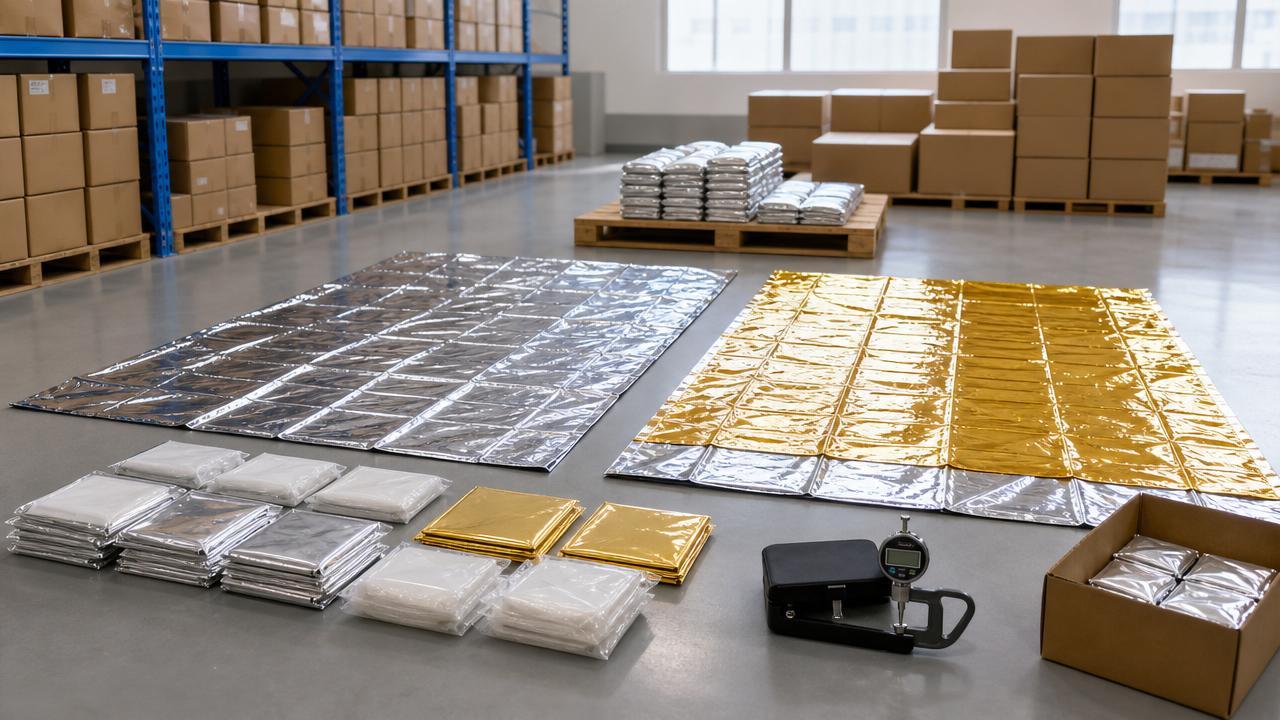
Cost also depends on whether the blanket is single-sided silver, dual-sided silver, gold-silver, or reinforced with additional layers.
Gold-silver designs often cost more because they support visibility, triage coding, and outdoor recognition.
Thickness is another major factor in wholesale emergency blankets pricing.
Ultra-light blankets may reduce freight cost, but they can feel fragile in demanding field conditions.
Thicker blankets improve durability and perceived value, although the raw material cost rises.
How does material grade affect wholesale emergency blankets cost?
Material grade defines the baseline for performance, safety, and price.
Low-cost wholesale emergency blankets may satisfy short-term promotional use, but they may not fit medical, rescue, or disaster-response expectations.
Premium film grades generally provide better puncture resistance and more stable heat-reflective performance.
For emergency kits, outdoor survival packs, and evacuation supplies, durability can influence complaint rates and repeat orders.
A small difference in film thickness may change both material consumption and packaging volume.
That difference becomes important when wholesale emergency blankets are ordered by carton, pallet, or container.
Common material and design options
- Standard metallized PET for compact emergency kits.
- Thicker PET film for rescue, camping, and relief use.
- Gold-silver film for visibility and triage situations.
- Reinforced or laminated structures for repeated handling.
- Individually packed units for hygiene-sensitive distribution.
The cheapest quotation may hide thinner film, weaker folding control, or less consistent coating.
When comparing wholesale emergency blankets, request material specifications rather than relying only on photos.
Why do order volume and MOQ change the final price?
Order volume has a direct effect on wholesale emergency blankets pricing because production setup costs are spread across more units.
Larger orders can reduce per-unit costs for film procurement, cutting, folding, packing, and carton handling.
Minimum order quantity also matters.
A supplier may offer low unit pricing only when the order meets efficient production thresholds.
Small trial orders usually include higher labor, packaging, documentation, and internal handling cost per blanket.
For wholesale emergency blankets, tiered pricing is common and should be reviewed carefully.
Volume planning should include forecasted demand, storage limits, and shelf-life assumptions.
Bulk purchasing helps reduce cost, but excessive stock can create cash pressure and warehouse congestion.
How do packaging and customization influence price?
Packaging is one of the most underestimated cost drivers in wholesale emergency blankets sourcing.
A bulk-packed blanket costs less than an individually sealed unit with printed instructions.
Retail-ready packaging adds design, printing, sealing, labeling, barcode control, and carton arrangement work.
Custom branding also affects lead time, especially when artwork approval, plate making, or color matching is required.
Wholesale emergency blankets for pharmacies, outdoor chains, and survival kits often require different packaging formats.
That means two quotes with identical blanket dimensions may still show very different final prices.
Typical packaging options
- Bulk carton packing for relief stockpiles.
- Individual polybag packing for hygiene control.
- Printed pouch packing for retail shelves.
- Kit-ready packing for first aid sets.
- Multilingual instruction inserts for regulated markets.
Packaging should match the sales channel, not just the lowest possible cost.
Over-packaging can waste margin, while under-packaging can reduce trust and increase product returns.
What compliance and quality checks should be priced in?
Compliance requirements can change the real cost of wholesale emergency blankets.
Markets may require product labeling, material safety documentation, packaging traceability, or conformity declarations.
Medical-adjacent use, institutional tenders, and government supply programs often require stricter documentation.
Testing can include dimensions, weight, reflectivity, tensile strength, odor, packaging integrity, and carton drop performance.
These checks add cost, but they reduce disputes and failed deliveries.
For wholesale emergency blankets, documented quality control is especially valuable when orders support urgent public needs.
Questions to ask before confirming a quote
- What is the actual film thickness and tolerance?
- Is the blanket individually packed or bulk packed?
- Are samples from mass production or a separate sample run?
- What inspection standard is used before shipment?
- Are test reports available for the target market?
- Does the quotation include labels, cartons, and documents?
A professional quote should show more than an attractive unit price.
It should clarify specifications, packaging, lead time, payment terms, and shipment assumptions.
How do freight, lead time, and supply stability affect landed cost?
The landed cost of wholesale emergency blankets includes freight, duties, insurance, inspection, and local handling.
Emergency blankets are lightweight, but carton volume can become significant at scale.
This means freight mode and packing efficiency can affect total cost more than expected.
Air freight supports urgent replenishment but may erase margin on lower-priced products.
Sea freight usually improves unit economics, but it requires longer planning and stronger forecasting.
Lead time also changes pricing when raw material availability tightens or seasonal demand rises.
Demand for wholesale emergency blankets can increase after natural disasters, cold waves, or public procurement announcements.
During these periods, suppliers may adjust prices because film stock, labor, and freight capacity become constrained.
Landed cost checklist
- Unit price by quantity tier.
- Carton quantity and carton dimensions.
- Gross weight and volumetric weight.
- Shipping term, such as EXW, FOB, CIF, or DDP.
- Import duty, tax, and customs documentation.
- Inspection, warehousing, and last-mile distribution.
A low factory price can become expensive if cartons are inefficient or delivery terms are unclear.
Always compare wholesale emergency blankets using landed cost, not only ex-factory cost.
Which price differences are warning signs?
Very low pricing can be legitimate when a supplier has efficient production and stable material purchasing.
However, extreme discounts should trigger a deeper review.
For wholesale emergency blankets, suspiciously low offers may involve thinner film, inaccurate dimensions, weak packaging, or missing documents.
Another warning sign is a quote that avoids technical detail.
If a supplier cannot confirm weight, thickness, carton data, or inspection methods, comparison becomes unreliable.
Price volatility also deserves attention.
Frequent unexplained changes may indicate unstable raw material sourcing or poor production planning.
A strong sourcing decision balances cost, performance, documentation, and delivery dependability.
FAQ: practical answers on wholesale emergency blankets pricing
The best approach is to build a quotation template for wholesale emergency blankets before requesting offers.
That template should require film data, dimensions, packaging, carton information, compliance documents, and delivery terms.
How should a sourcing decision be made?
A reliable sourcing decision begins with a clear use case.
Disaster relief stock, hospital warming support, outdoor retail, and first aid kits do not require identical specifications.
Define the expected environment, handling frequency, packaging need, and compliance level before negotiating price.
Then compare wholesale emergency blankets by value, not only by visible cost.
A slightly higher unit price may reduce failures, improve presentation, and support smoother tender approval.
The final quote should identify what is included and what remains excluded.
This prevents surprises in freight, labels, inspection, documentation, and customs handling.
For wholesale emergency blankets, price transparency is a practical advantage.
It allows better margin planning, fewer delivery disputes, and stronger continuity when urgent demand appears.
Before placing an order, request comparable samples, verify specifications, calculate landed cost, and confirm lead time in writing.
This disciplined process turns wholesale emergency blankets sourcing from price chasing into controlled, repeatable procurement.
Expert Insights

Chief Security Architect
Dr. Thorne specializes in the intersection of structural engineering and digital resilience. He has advised three G7 governments on industrial infrastructure security.
Related Analysis
Core Sector // 01
Security & Safety
- Regulatory Compliance gaps that delay pharma launchesAuthor :Dr. Elena Carbon

- Lab-to-Pilot Reactor Scale-Up: Managing Mixing and Heat TransferAuthor :Dr. Elena Carbon

- Biomanufacturing Equipment in Southeast Asia: Evaluating Suppliers and Local SupportAuthor :Dr. Elena Carbon

- Choosing Microplate Washers for Assay Labs: Residual Volume and Plate CompatibilityAuthor :Dr. Elena Carbon

- Automated Buffer Preparation: Troubleshooting pH and Conductivity DriftAuthor :Dr. Elena Carbon

- How to Select an Overhead Crane Pendant Control for Safe, Reliable OperationAuthor :Dr. Elena Carbon

- What Drives Ingredient Processing Equipment Prices Beyond Initial Purchase Cost?Author :Dr. Elena Carbon

- Selecting Modular Chemical Synthesis Equipment for Scalable Process DevelopmentAuthor :Dr. Elena Carbon