Titration Accuracy Data That Actually Predicts Endpoints
Author
Date Published
Reading Time

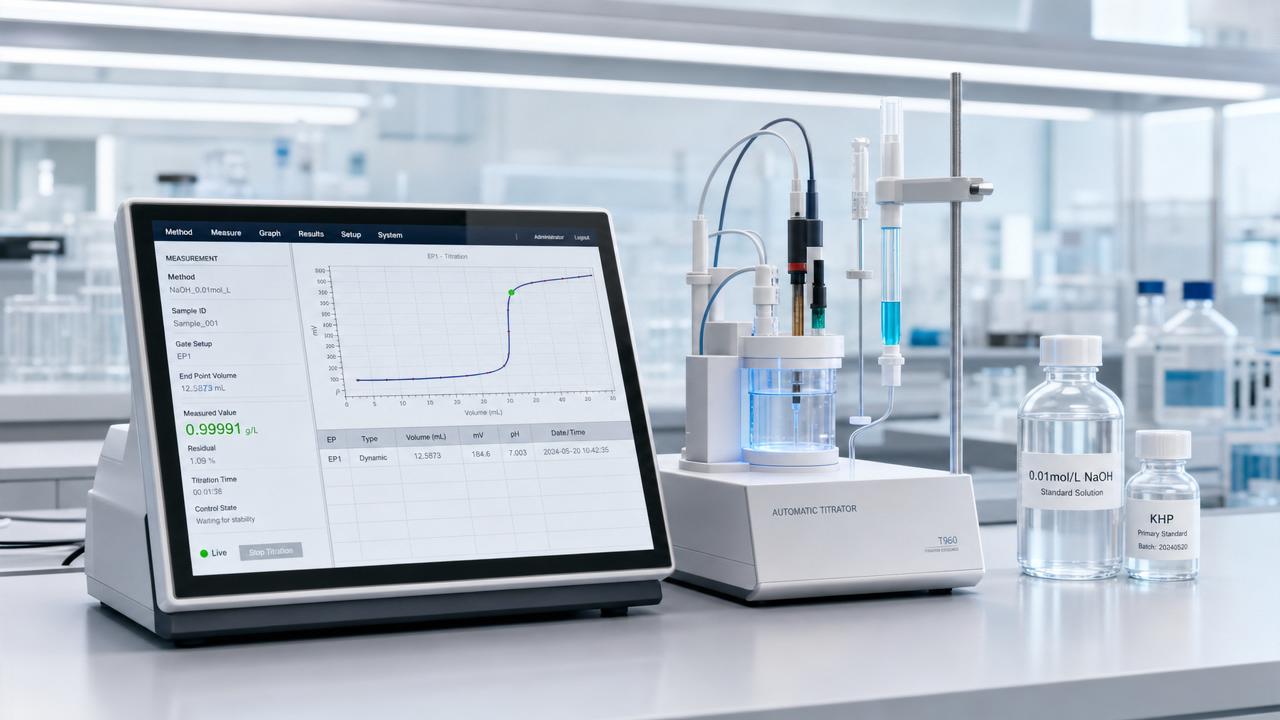
For technical evaluators comparing analytical systems, titration accuracy and sensitivity data matter only when they reliably forecast real endpoint behavior under production-relevant conditions. This article examines how to interpret performance metrics beyond headline specifications, linking precision, signal response, and method stability to practical decision-making in regulated laboratory and pilot-scale environments.
Why titration accuracy and sensitivity data often fail in real endpoint prediction
Technical evaluators rarely struggle to find specifications. The harder task is deciding whether titration accuracy and sensitivity data from brochures, factory acceptance tests, or isolated validation reports will still predict endpoint behavior once the system is exposed to variable matrices, mixed operators, and time-sensitive workflows. In pharmaceutical, chemical, and advanced process laboratories, endpoint reliability is a scale-up risk issue, not a single-number specification issue.
A titration platform may show excellent repeatability under ideal conditions yet underperform when viscosity changes, dissolved gases interfere, sample conductivity drifts, or reagent aging affects signal response. The practical problem for evaluators is that endpoint prediction depends on a chain of interacting variables: dosing precision, sensor response time, mixing efficiency, algorithm logic, environmental stability, and method robustness across actual production-relevant samples.
This is where G-LSP brings value. By connecting lab-scale fluidic behavior with pilot-scale execution, it frames titration accuracy and sensitivity data as part of a broader architecture of micro-efficiency. That means the evaluator does not ask only, “How accurate is the instrument?” but also, “How accurately does the full fluidic system predict decision-grade endpoints under regulated operating conditions?”
- Headline accuracy without matrix-specific verification can mask endpoint drift in buffered, turbid, or biologically active samples.
- Sensitivity claims may reflect sensor responsiveness, but not the system’s ability to distinguish true inflection points from noise.
- Bench validation can be misleading if the production workflow introduces different reagent lots, vessel geometries, or operator handling practices.
- Procurement errors often occur when teams compare devices instead of comparing endpoint confidence under intended use conditions.
What technical evaluators should measure beyond basic specifications
A more useful interpretation of titration accuracy and sensitivity data starts with separating laboratory precision from endpoint predictiveness. Precision describes closeness among repeated results. Predictiveness describes how well those results identify the actual endpoint under process-relevant conditions. For regulated labs, both matter, but they are not interchangeable.
Core performance dimensions that influence endpoint confidence
When G-LSP benchmarks analytical and fluidic systems, the focus extends to the conditions that distort interpretation. A system that performs well in one dimension but poorly in another can create false confidence. Evaluators should review the dimensions below as a linked framework rather than a checklist of isolated claims.
This table shows why titration accuracy and sensitivity data should be evaluated as a system behavior profile. The most costly failures usually come from interactions between dosing, sensing, and sample handling rather than from a single catastrophic component error.
Questions evaluators should ask suppliers
- What matrices were used to generate the published titration accuracy and sensitivity data, and how close are they to our process samples?
- Were results generated under continuous use, multi-operator use, or only under controlled demonstration conditions?
- How does the system detect or compensate for drift, lag, air bubbles, carryover, and unstable baseline signals?
- Can endpoint performance be documented against methods aligned with ISO, USP, or GMP expectations where relevant?
Which application scenarios demand stricter interpretation of titration accuracy and sensitivity data?
Not every titration workflow carries the same risk. Some applications tolerate moderate variation because the endpoint is broad and the result is used for internal trend tracking. Others require tighter confidence because the result affects batch release, formulation adjustment, raw material qualification, or pilot-scale process transfer. Technical evaluators should assign stricter interpretation rules where endpoint error has downstream quality, cost, or compliance consequences.
High-sensitivity environments where endpoint prediction matters most
- Raw material qualification for pharmaceutical and specialty chemical inputs, where borderline acceptance limits demand stable endpoint discrimination.
- Pilot-scale reaction control, where acid-base or redox endpoint interpretation may influence feed timing, neutralization, or quench decisions.
- Cell culture and bioprocess support testing, where sample complexity and biological load can affect response stability and signal clarity.
- Microfluidic and low-volume analytical workflows, where sub-microliter dispensing deviations can become analytically significant.
Because G-LSP covers pilot-scale reactors, precision microfluidics, bioreactor infrastructure, centrifugation, and automated liquid handling, it is especially well positioned to assess titration accuracy and sensitivity data in context. Endpoint prediction does not exist in a vacuum. It depends on upstream sample integrity, downstream process consequences, and the fluidic precision of connected systems.
The following scenario table helps evaluators map risk level to the level of scrutiny required during procurement and method transfer.
The interpretation is straightforward: the more dynamic the sample and the more expensive the decision linked to the endpoint, the less useful generic titration accuracy and sensitivity data become. Evaluators need use-case evidence, not only specification sheets.
How to compare systems during procurement without overvaluing brochure numbers
Procurement teams often compare analytical systems in a linear way: accuracy, then price, then lead time. That approach is risky for endpoint-driven workflows because it ignores failure cost. A lower-cost system can become more expensive if it increases rework, retesting, delayed release, or method redevelopment. Technical evaluators need a weighted comparison model built around total decision confidence.
A practical selection framework for technical evaluators
The procurement guide below translates titration accuracy and sensitivity data into buying criteria that are easier to defend internally across engineering, quality, and purchasing teams.
A structured comparison keeps teams from overemphasizing nominal accuracy while overlooking method transfer risk. This is especially important when analytical systems will support scale transition from benchtop development to pilot or preproduction environments.
Common procurement mistakes
- Selecting on sensor resolution alone without checking response stability in actual sample chemistry.
- Assuming good titration accuracy and sensitivity data in water-based standards will transfer to viscous or particulate samples.
- Ignoring upstream sample handling variables such as centrifugation, degassing, or pipetting precision.
- Treating compliance documentation as an administrative issue instead of a technical selection factor.
Standards, compliance, and data integrity: what evaluators should verify
In regulated or audit-sensitive environments, titration accuracy and sensitivity data must be credible, traceable, and method-relevant. Even when a workflow is not directly tied to final product release, technical teams still benefit from compliance discipline because it improves comparability, reduces undocumented drift, and supports smoother technology transfer across sites.
Compliance-oriented verification checklist
- Confirm whether calibration routines are documented and reproducible across operators and shifts.
- Review how raw endpoint signals, processed data, and final reported values are stored and traceable.
- Check whether method settings can be version-controlled to support consistent validation and requalification.
- Verify that the system can be assessed within broader ISO, USP, and GMP-aligned workflows where needed.
For organizations managing sensitive R&D-to-production transitions, these points are not paperwork details. They determine whether endpoint evidence can be trusted when methods are transferred between labs, scaled into pilot systems, or reviewed after deviations. G-LSP’s benchmarking perspective is useful here because it links analytical performance to the surrounding hardware and process context that often drive compliance risk.
FAQ: practical questions about titration accuracy and sensitivity data
How should I judge titration accuracy and sensitivity data when sample matrices change frequently?
Use matrix variability as a primary evaluation condition, not a secondary concern. Request performance evidence on representative acidic, buffered, viscous, or particulate samples if those reflect your workflow. If that is not possible, run an internal trial using the same sample preparation, vessel geometry, and dosing range expected during routine use. Stable endpoint prediction across matrix changes matters more than best-case laboratory precision.
What matters more: sensor sensitivity or dosing precision?
Neither should be isolated. High sensitivity without stable dosing can exaggerate noise, while good dosing without sufficient signal discrimination can flatten endpoint resolution. The better question is whether the full system can separate the true endpoint from process variation. For low-volume or steep-curve methods, dosing precision may dominate. For complex biological or weak-inflection samples, signal quality may dominate.
Are brochure specifications enough for procurement approval?
Usually not when the method affects quality-critical decisions. Brochure-level titration accuracy and sensitivity data are useful for initial screening, but technical approval should also consider matrix-specific performance, operator repeatability, serviceability, and documentation support. The more regulated or scale-sensitive the workflow, the less adequate generic specifications become.
What is the most common evaluation mistake in pilot-scale environments?
Teams often validate the titrator as if it were independent from the rest of the process. In reality, sample conditioning, mixing, upstream separation, and liquid handling precision can all change endpoint behavior. In pilot-scale work, evaluate the titration method as part of a fluidic chain, not a standalone instrument.
Why choose us for benchmarking and selection support
For technical evaluators, the value of G-LSP is not generic product promotion. It is the ability to interpret titration accuracy and sensitivity data within the broader architecture of lab-scale production, precision fluidics, and regulated scale transition. Because the platform spans reactors, microfluidic devices, bioreactor infrastructure, centrifugation, and automated liquid handling, it can help identify where endpoint risk actually originates and which equipment interactions deserve the closest scrutiny.
If you are comparing systems for analytical development, QC modernization, pilot-scale transfer, or integrated liquid handling workflows, you can consult us on specific decision points rather than broad claims. That includes parameter confirmation, selection criteria for production-relevant matrices, delivery timing considerations for evaluation projects, documentation expectations for regulated environments, sample handling compatibility, and quotation alignment with required performance evidence.
- Request support for interpreting titration accuracy and sensitivity data against your actual endpoint risk profile.
- Discuss product selection based on sample type, volume range, compliance expectations, and fluidic integration needs.
- Ask about delivery planning, validation implications, and implementation sequencing for new or replacement systems.
- Use G-LSP benchmarking insight to compare alternatives before committing budget to a method-critical platform.
When endpoint reliability affects release timing, process confidence, or scale-up decisions, selection should be evidence-led. A focused consultation can clarify whether published titration accuracy and sensitivity data truly match your workflow, or whether additional verification is needed before purchase.
Expert Insights

Chief Security Architect
Dr. Thorne specializes in the intersection of structural engineering and digital resilience. He has advised three G7 governments on industrial infrastructure security.
Related Analysis
Core Sector // 01
Security & Safety
- Ultra-Low-Volume Dispensing: Evaluating Accuracy and Precision at Nanoliter ScaleAuthor :Lina Cloud

- Dial Indicators in Bulk: Accuracy Grades, Mounting Styles, and Supplier ChecksAuthor :Lina Cloud

- Why hydraulic hoses bulk orders fail pressure checks?Author :Lina Cloud

- How to Vet a Titration System OEM Supplier Before Scale-UpAuthor :Lina Cloud

- Titration Accuracy and Sensitivity Data That Actually MatterAuthor :Lina Cloud

- Choosing a Peristaltic Pump for Lab Wholesale Without OverbuyingAuthor :Lina Cloud

- How Much Titration Accuracy Is Enough for Routine QC Work?Author :Lina Cloud

- Why automated buffer preparation factory output can vary by batchAuthor :Lina Cloud