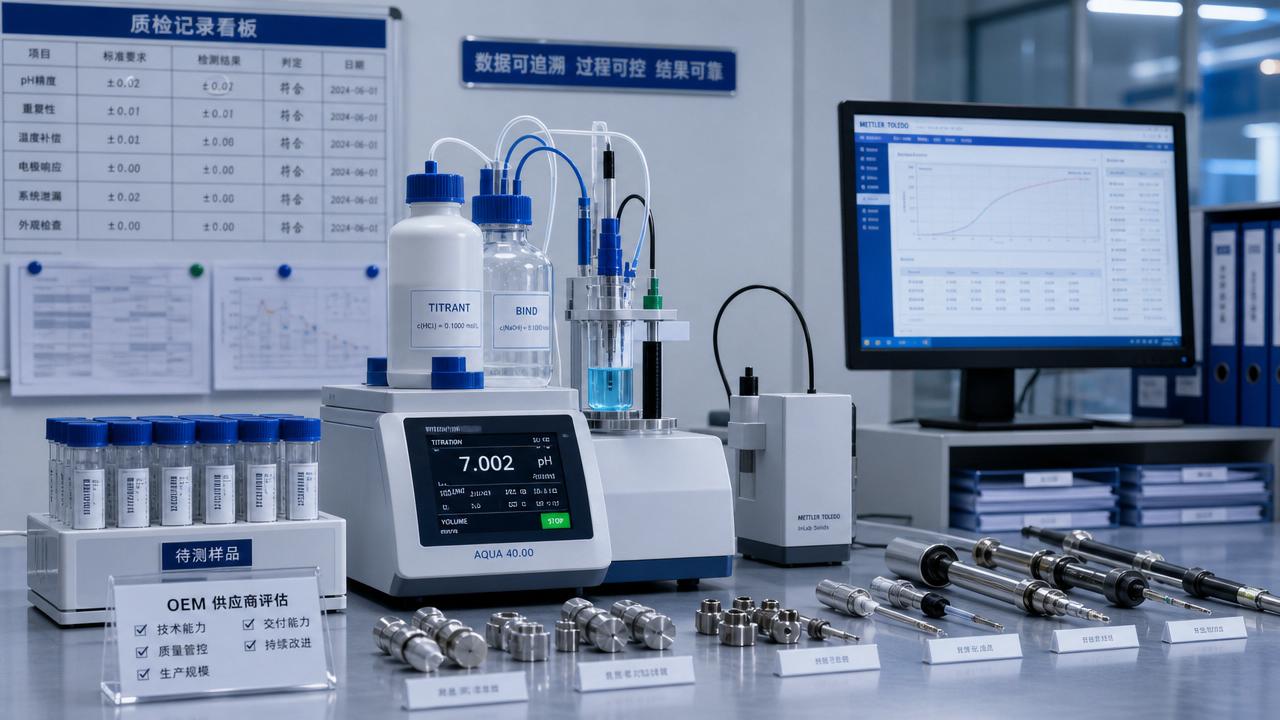
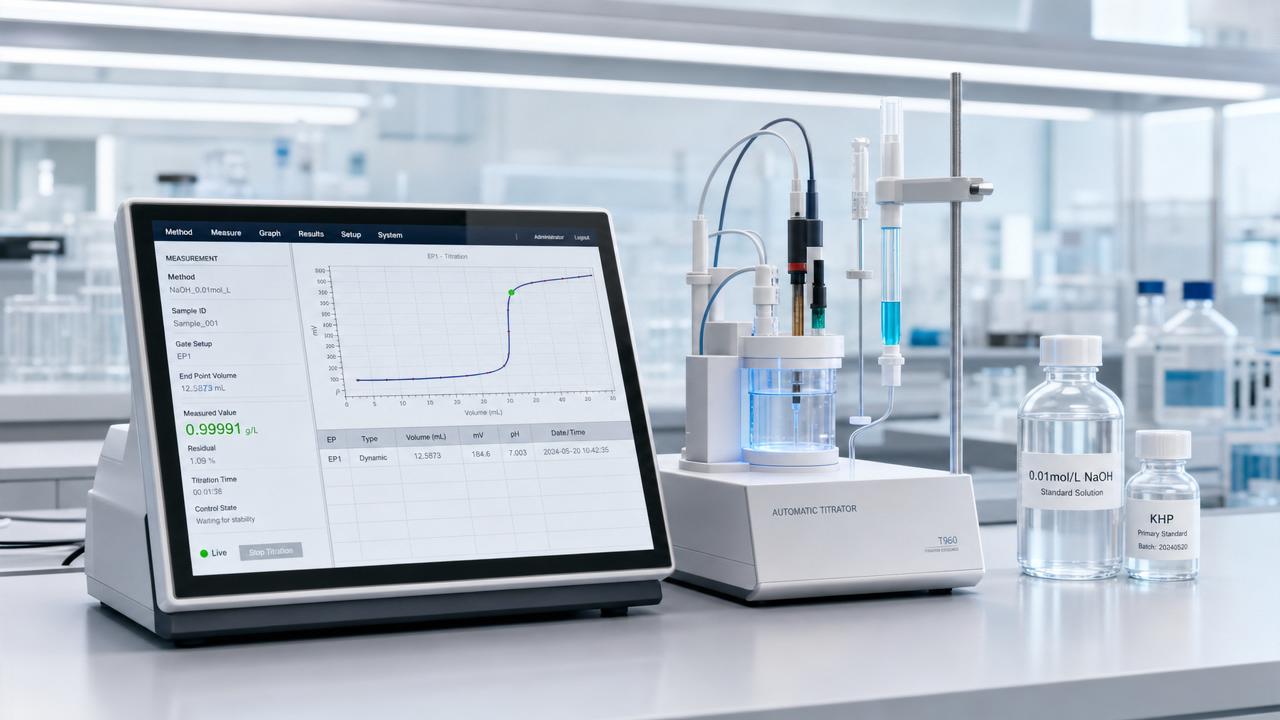
Titration Accuracy and Sensitivity Data Can Mislead Without Context
Author
Date Published
Reading Time

Titration accuracy and sensitivity data often appear decisive, yet without method design, sample matrix, endpoint logic, and instrument conditions, they can distort real-world conclusions. For researchers comparing systems or validating analytical performance, context is what separates impressive numbers from reliable decision-making. This article explores how to read these metrics critically in complex lab and production environments.
What titration accuracy and sensitivity data really mean
In analytical work, titration accuracy and sensitivity data are often used as shorthand for method quality. Accuracy usually refers to how closely a measured result matches a known or accepted value. Sensitivity refers to how well a method detects small concentration changes or small endpoint shifts. On paper, both are valuable. In practice, however, the numbers only become meaningful when tied to a defined method, a specific analyte, and a realistic operating environment.
This distinction matters across the broader laboratory and process industry, especially where fluidic precision influences scale-up, release testing, formulation work, and in-process control. A reported accuracy figure may come from a clean standard solution under highly controlled conditions, while a production laboratory handles viscous, buffered, multiphase, or unstable samples. Likewise, sensitivity values may be obtained with ideal electrode response, fresh reagents, and optimized stirring, yet field conditions rarely remain ideal for long.
As a result, decision-makers should treat titration performance metrics as contextual indicators rather than absolute truths. For information researchers, this is especially important when comparing white papers, technical datasheets, validation packages, and benchmark claims from multiple vendors or laboratories.
Why the industry pays close attention to these metrics
In pharmaceutical, chemical, and advanced R&D environments, titration is still a practical and trusted tool for quantifying acidity, alkalinity, water content, chloride, redox-active species, assay values, and process-related impurities. The method remains attractive because it can be robust, standardized, and relatively efficient. Yet the growing shift from batch development to continuous processing and personalized production creates more pressure to understand whether titration accuracy and sensitivity data remain valid across changing sample conditions.
Organizations such as G-LSP operate in precisely this transition space, where benchtop findings must survive industrial realities. A fluidic system that performs elegantly in a controlled demonstration may face very different demands in pilot reactors, single-use bioprocess systems, microfluidic workflows, or automated liquid handling environments. When analytical claims are taken out of context, teams may overestimate process capability, misjudge method transfer readiness, or select hardware that underperforms under GMP or ISO-driven expectations.
For procurement officers and lab directors, the issue is not only scientific correctness. It is operational risk. A misunderstood sensitivity claim can trigger unnecessary instrument upgrades. A misread accuracy statement can lead to validation delays, batch investigations, specification disputes, or inconsistent data trending between sites.
The context variables that change the meaning of performance data
The most useful way to read titration accuracy and sensitivity data is to ask what conditions produced the result. Four context layers matter most.
Method design
Titration type, titrant concentration, endpoint detection mode, sample size, and calculation model all shape the final performance claim. Potentiometric titration behaves differently from colorimetric titration. Karl Fischer methods differ from acid-base methods. Even a minor change in burette resolution or dosing algorithm can alter endpoint stability and apparent repeatability.
Sample matrix
Clean standards do not represent every real sample. Buffers, salts, suspended solids, emulsions, proteins, solvents, surfactants, and reactive intermediates can all change electrode response or endpoint sharpness. A method that looks highly sensitive in water may become ambiguous in a fermentation broth or synthesis stream.
Instrument and fluidics condition
Delivery precision, valve integrity, tubing compatibility, mixing quality, temperature control, and sensor health all influence performance. This is one reason fluidic-precision benchmarking matters. Small dosing errors or poor mixing can create false impressions of chemical variability when the real issue is hardware inconsistency.
Operator and environment
Manual preparation, reagent aging, calibration interval, room temperature, and SOP interpretation also affect results. Two labs may report different titration accuracy and sensitivity data not because one system is better, but because preparation discipline, sample handling, or endpoint review standards differ.
Industry overview: where contextual reading matters most
The importance of context is not uniform across all operations. Some environments are far more vulnerable to misleading performance claims than others.
How misleading interpretations happen in practice
A common mistake is to compare one vendor’s best-case sensitivity value with another vendor’s routine-use accuracy range. Those are not equivalent claims. Another frequent error is treating endpoint resolution as proof of method suitability without asking whether the sample’s chemistry remains stable throughout the titration window.
Misinterpretation also happens when teams separate analytical performance from fluidic architecture. In high-precision environments, delivery accuracy, dead volume, carryover control, and mixing dynamics can be just as important as the chemistry itself. This is highly relevant for multidisciplinary platforms such as pilot-scale reactors, precision dispensers, and automated pipetting systems, where the analytical readout may depend on upstream handling quality.
Even valid validation data can mislead when readers forget the intended use. A method validated for a narrow concentration band may not perform similarly near the limit of quantitation or in atypical formulations. Sensitivity that is excellent for development screening may be unnecessary or unstable for routine manufacturing release.
Business value of reading titration data with context
For information researchers and technical evaluators, contextual interpretation turns raw metrics into usable intelligence. It helps determine whether published titration accuracy and sensitivity data support method adoption, hardware comparison, validation strategy, or only preliminary screening. That distinction protects organizations from investing in solutions that look strong in marketing material but are weak in actual process integration.
There is also a regulatory and quality value. Under GMP-oriented thinking, data integrity is not just about storing results correctly. It also depends on whether the method was interpreted appropriately, whether performance claims were fit for purpose, and whether acceptance criteria reflected actual risk. Context reduces the chance of false precision, where numbers appear exact but decision confidence is low.
From an operational standpoint, better interpretation supports smoother method transfer, more realistic instrument qualification, and stronger cross-functional communication between analytical scientists, engineers, and procurement teams.
Typical evaluation scenarios and what to check
Practical guidance for interpreting titration accuracy and sensitivity data
A sound review process starts with one question: compared to what conditions? Before accepting a performance claim, identify the analyte, concentration range, endpoint strategy, temperature, sample matrix, and hardware setup. If any of these are unclear, the data may still be interesting, but they are not yet decision-ready.
Second, separate intrinsic method capability from system-level capability. A chemistry can be excellent while the fluidic platform introduces variability. Conversely, a precise dosing platform cannot rescue a poorly chosen endpoint model. In integrated laboratories, both layers must be benchmarked together.
Third, review whether the reported sensitivity is actually useful. More sensitivity is not always better. Extremely fine endpoint response may increase susceptibility to noise, drift, or operator interpretation. The best analytical performance is the one that remains stable and actionable in the intended workflow.
Fourth, examine repeatability over time rather than only initial validation results. Reagent aging, electrode fouling, tubing wear, and maintenance quality can narrow the gap between theoretical and real performance. Long-term stability often tells more than a single impressive demonstration.
Finally, connect data interpretation to business use. If the goal is early research screening, some uncertainty may be acceptable. If the goal is release testing or a sensitive scale-up decision, the tolerance for context gaps should be much lower.
A balanced way to use these metrics in modern lab environments
The best use of titration accuracy and sensitivity data is not to treat them as isolated proof points, but as part of a broader evidence chain that includes method intent, sample realism, fluidic reliability, and compliance relevance. This balanced view is increasingly important in environments where laboratory systems must support both innovation speed and production discipline.
For organizations evaluating analytical systems, microfluidic tools, pilot-scale platforms, or automated liquid handling infrastructure, contextual reading creates better alignment between technical claims and operational outcomes. It helps teams ask stronger questions, build more realistic benchmarks, and avoid costly misinterpretation.
Conclusion and next-step perspective
In today’s multidisciplinary laboratory landscape, numbers alone rarely tell the full story. Titration accuracy and sensitivity data can inform smart decisions only when linked to method design, matrix complexity, instrument condition, and intended use. For information researchers, that means looking past headline values and toward the architecture behind them.
If your team is comparing systems, validating methods, or mapping lab-scale results to production reality, use contextual benchmarking as the standard. It is the most reliable way to turn analytical claims into defensible technical decisions.
Expert Insights

Chief Security Architect
Dr. Thorne specializes in the intersection of structural engineering and digital resilience. He has advised three G7 governments on industrial infrastructure security.
Related Analysis
Core Sector // 01
Security & Safety
- Ultra-Low-Volume Dispensing: Evaluating Accuracy and Precision at Nanoliter ScaleAuthor :Lina Cloud

- Dial Indicators in Bulk: Accuracy Grades, Mounting Styles, and Supplier ChecksAuthor :Lina Cloud

- Why hydraulic hoses bulk orders fail pressure checks?Author :Lina Cloud

- How to Vet a Titration System OEM Supplier Before Scale-UpAuthor :Lina Cloud

- Titration Accuracy and Sensitivity Data That Actually MatterAuthor :Lina Cloud

- Choosing a Peristaltic Pump for Lab Wholesale Without OverbuyingAuthor :Lina Cloud

- How Much Titration Accuracy Is Enough for Routine QC Work?Author :Lina Cloud

- Why automated buffer preparation factory output can vary by batchAuthor :Lina Cloud