Reagent Dispenser OEM Factory: Capacity Claims to Verify
Author
Date Published
Reading Time
Choosing a reagent dispenser OEM factory goes far beyond comparing brochure specs. For procurement teams in regulated lab and pilot-scale environments, claimed output, dosing accuracy, and production scalability must be verified against real manufacturing capability. This article highlights the key capacity claims to examine before supplier selection, helping buyers reduce sourcing risk and secure consistent fluid-handling performance.
Why procurement teams should use a verification checklist first
When evaluating a reagent dispenser OEM factory, the biggest mistake is treating capacity as a single number. A supplier may state monthly output, high precision, or rapid lead time, yet those claims can mean very different things depending on product mix, validation burden, component sourcing, and test standards. For buyers in pharmaceutical, chemical, diagnostics, and advanced laboratory settings, a checklist-based review is the fastest way to separate true manufacturing capability from sales language.
This matters especially in fluid-handling systems, where the gap between prototype performance and repeatable factory output can be large. A line that can assemble 5,000 simple dispensing units per month may only support a fraction of that volume when the build includes calibration, traceability records, IQ/OQ-related documentation support, or tighter wetted-material controls. Procurement officers therefore need to verify not just whether a reagent dispenser OEM factory can build the product, but whether it can build it repeatedly, accurately, and at the required release pace.
Core checklist: capacity claims to verify before shortlisting
Use the following checklist as an initial qualification screen. These are the claims most likely to affect supply continuity, compliance readiness, and total acquisition risk.
- Rated monthly output by product type: Ask whether the stated capacity applies to manual dispensers, semi-automatic units, or integrated liquid handling modules. Product complexity can reduce real throughput dramatically.
- Capacity under validated conditions: Confirm whether output numbers reflect engineering builds only or fully tested and documented production lots.
- Dosing accuracy at production volume: Verify whether precision data were generated from sample units or from statistically relevant production runs.
- Calibration station bottlenecks: Many suppliers can assemble quickly but have limited calibration benches, which slows release.
- Critical component availability: Pumps, valves, sensors, seals, and molded wetted parts often determine true output more than assembly labor.
- Changeover time between SKUs: A reagent dispenser OEM factory serving many variants may lose efficiency during tooling, programming, or cleaning transitions.
- Yield and rework rate: High nominal output is less valuable if a significant percentage requires retest or rebuild.
- Scalability beyond current demand: Ask what capacity can be reached in 3, 6, and 12 months without compromising metrology standards.
How to judge production capacity claims, not just read them
1. Check whether “capacity” means assembly, testing, or shipment
In OEM sourcing, capacity can be presented in at least three ways: units assembled, units calibrated and tested, or units ready to ship with full documentation. Procurement should request all three figures separately. A reagent dispenser OEM factory may assemble 2,000 units per month, but only calibrate 800 and release 500 if documentation review is manual. The shipment-ready number is usually the most relevant one for planning.
2. Verify throughput by dose range and fluid class
Not all reagent dispensing applications are equal. Low-viscosity aqueous reagents, aggressive solvents, buffer systems, and biologically sensitive fluids impose different demands on wetted-path materials, seal integrity, and repeatability testing. A reagent dispenser OEM factory that performs well for standard chemistry may not sustain the same line speed for corrosive or sterile-sensitive applications. Always tie capacity claims to your actual liquid profile and target dispense volume range.
3. Look for evidence of metrology discipline
Capacity without measurement discipline is not useful in regulated environments. Ask how the factory verifies dispense accuracy, repeatability, drift, and lot-to-lot consistency. Key indicators include calibrated balances, traceable reference standards, environmental controls during testing, gauge R&R practices, and digital data capture. If the supplier cannot explain how its measured performance supports its throughput claims, the production number is incomplete.
4. Compare installed equipment against claimed output
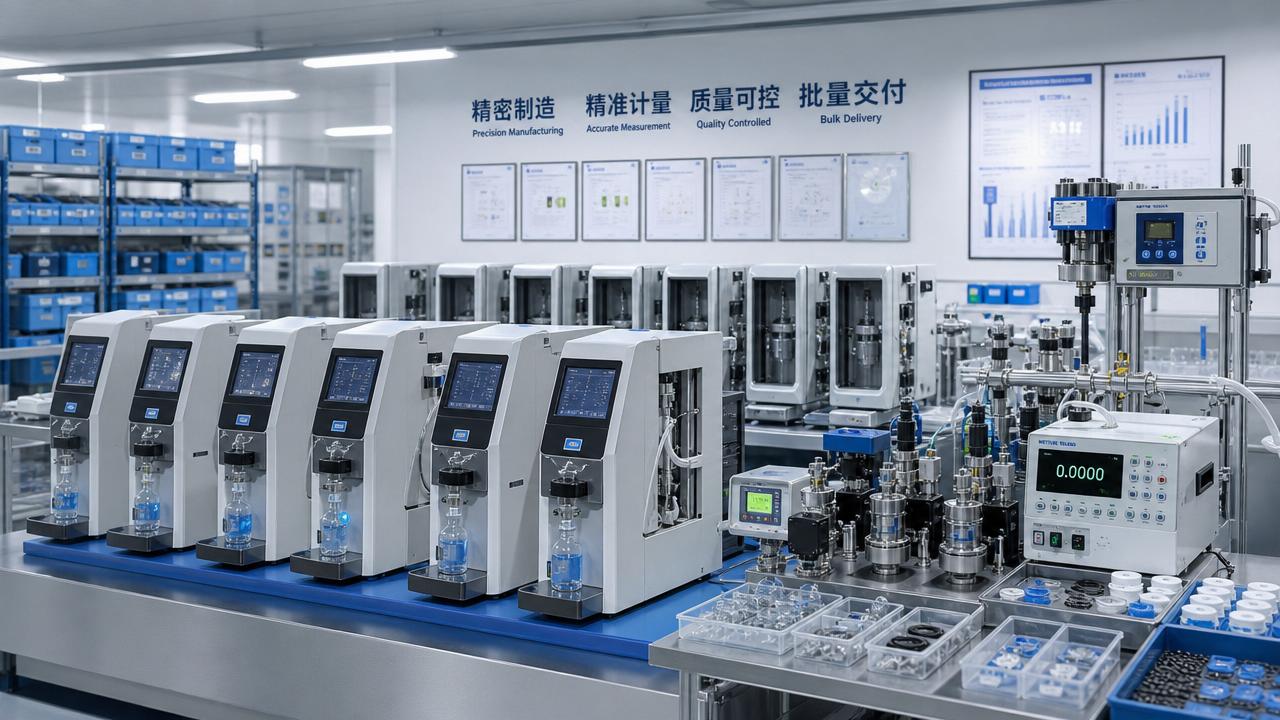
A practical buyer should map claims to physical assets. How many assembly stations, leak-test positions, calibration benches, firmware loading terminals, and packaging lines are in operation? How many shifts are running? What is the uptime of these stations? A reagent dispenser OEM factory with one critical calibration cell cannot credibly promise aggressive scale-up if that cell is already near saturation.
A simple verification table procurement teams can use
The table below helps translate supplier statements into decision-ready checkpoints.
Scenario-specific checks: what changes by application
For regulated pharmaceutical and biotech procurement
If your reagent dispenser will support GMP-adjacent development, QC workflows, or sensitive formulation work, prioritize document control as much as hardware capacity. Ask whether the reagent dispenser OEM factory can support material traceability, software version control, calibration records, and deviation handling. Even a technically strong supplier can become a weak partner if quality documentation is not production-grade.
For chemical and industrial lab users
Where fluids may be abrasive, corrosive, or volatile, verify compatibility testing and maintenance burden. Capacity claims must reflect the actual build materials used for these service conditions. Faster output is less important if the dispenser requires frequent seal replacement or if the supplier cannot maintain part consistency across lots.
For customized OEM programs
Customization changes the capacity discussion completely. Branding, enclosure redesign, communication interface adjustments, sensor integration, or altered dispense ranges can each add validation steps. In these cases, ask the reagent dispenser OEM factory for separate figures covering NPI stage, pilot build stage, and mature production stage. Procurement should never use mature-state capacity numbers to assess an unproven custom program.
Commonly overlooked warning signs in a reagent dispenser OEM factory review
- Capacity is quoted without a yield assumption. Good factories know their first-pass yield and rework ratio.
- Lead time sounds short because key parts are excluded. Ask which items are stocked, forecast-driven, or customer-supplied.
- Precision data are based on ideal fluids only. Your reagent matrix may produce very different performance.
- Audit access is restricted to presentation rooms. Limited visibility may hide bottlenecks in calibration, warehousing, or final QA.
- Scale-up relies on future hiring alone. Labor plans matter, but tooling, training, and process controls matter more.
- There is no clear separation between prototype and serial production. This often leads to unstable quality and unreliable planning.
Execution advice: how to validate claims before contract award
A disciplined sourcing process can reveal whether a reagent dispenser OEM factory is operationally ready. Start with a structured RFQ that requests capacity definitions, process flow, QA checkpoints, and component dependency details. Then move beyond documents.
- Request a process map. This should show assembly, calibration, test, packaging, and release steps.
- Ask for recent production evidence. Monthly output history, yield data, and on-time delivery are more useful than generic claims.
- Run a pilot order or FAT-style evaluation. Verify dosage consistency, documentation quality, and packaging discipline on a controlled batch.
- Audit bottleneck stations. Spend time where precision is proven, not where presentations are polished.
- Stress-test the timeline. Ask how output changes if demand rises by 30% or if one critical supplier slips by four weeks.
- Define acceptance metrics in the contract. Include output, accuracy, defect thresholds, and response obligations for deviations.
FAQ: quick answers buyers often need
How many suppliers should procurement compare?
For a strategic reagent dispenser OEM factory search, three to five serious candidates are usually enough if your checklist is rigorous and your technical specification is clear.
Is a factory tour always necessary?
For low-risk standard products, not always. For custom, regulated, or scale-sensitive programs, a site audit or remote live verification is strongly recommended.
What is the fastest red flag to identify?
If the supplier cannot clearly separate assembly capacity from tested-and-released capacity, treat every volume claim with caution.
What to prepare before contacting a supplier
To get useful answers from a reagent dispenser OEM factory, procurement should prepare several inputs in advance: expected annual and peak monthly volume, fluid characteristics, target dispense range, accuracy requirements, regulatory expectations, documentation needs, forecast horizon, and launch timing. The more precise your sourcing brief, the easier it is to test whether a supplier’s capacity claim fits your real program instead of a generic product category.
Final buyer takeaway
Selecting a reagent dispenser OEM factory is ultimately a capacity verification exercise, not a brochure comparison exercise. Procurement teams should prioritize shipment-ready output, validated dosing performance, bottleneck visibility, supply chain resilience, and documented scale-up logic. When those points are checked systematically, supplier selection becomes less subjective and far more resilient.
If you are moving to the next sourcing stage, the most productive discussion topics are clear: actual tested monthly capacity, component risk, customization impact, QA documentation capability, and the conditions under which quoted lead times remain valid. Those questions will do more to protect your program than any headline specification alone.
Expert Insights

Chief Security Architect
Dr. Thorne specializes in the intersection of structural engineering and digital resilience. He has advised three G7 governments on industrial infrastructure security.
Related Analysis
Core Sector // 01
Security & Safety
- Ultra-Low-Volume Dispensing: Evaluating Accuracy and Precision at Nanoliter ScaleAuthor :Lina Cloud

- Dial Indicators in Bulk: Accuracy Grades, Mounting Styles, and Supplier ChecksAuthor :Lina Cloud

- Why hydraulic hoses bulk orders fail pressure checks?Author :Lina Cloud

- How to Vet a Titration System OEM Supplier Before Scale-UpAuthor :Lina Cloud

- Titration Accuracy and Sensitivity Data That Actually MatterAuthor :Lina Cloud

- Choosing a Peristaltic Pump for Lab Wholesale Without OverbuyingAuthor :Lina Cloud

- How Much Titration Accuracy Is Enough for Routine QC Work?Author :Lina Cloud

- Why automated buffer preparation factory output can vary by batchAuthor :Lina Cloud