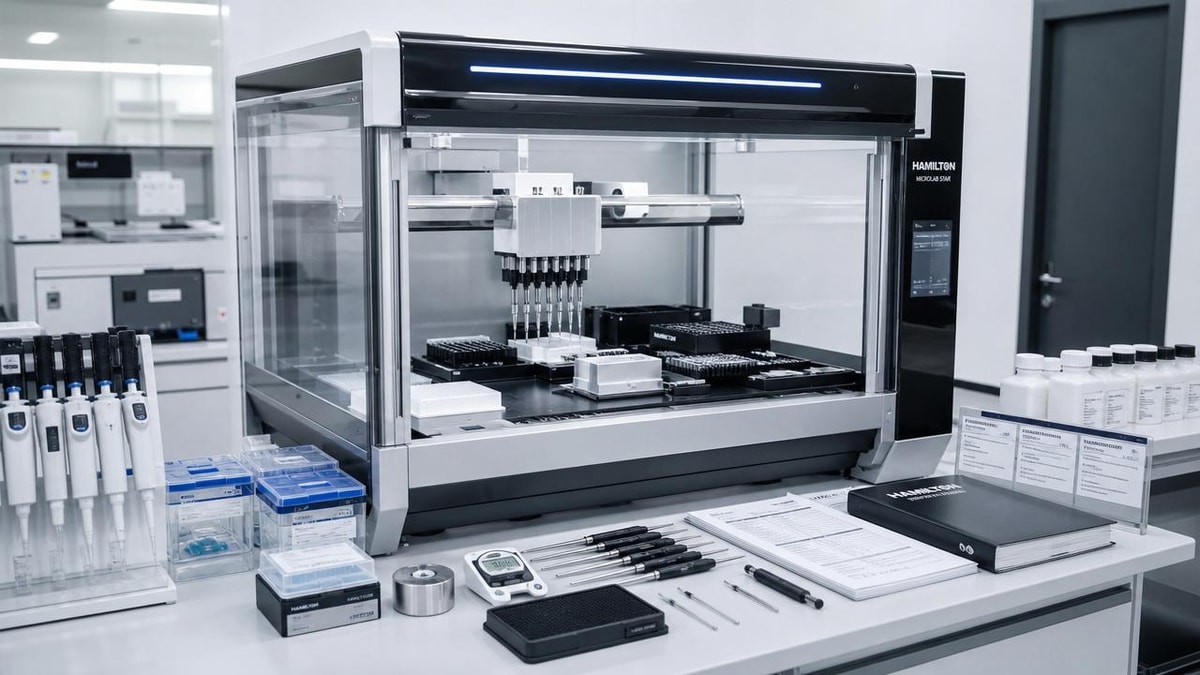
NMPA Issues Robotic Arm Liquid Registration Guidance
Author
Date Published
Reading Time

On May 2, 2026, China’s National Medical Products Administration (NMPA) released the Supplementary Guidance for Registration Review of Robotic Arm Liquid Handling Systems, mandating functional safety certification at PLd (per ISO 13849-1) or SIL3 (per IEC 61508) levels and requiring submission of 0.1-second emergency stop test videos under hand intrusion scenarios. This guidance directly affects manufacturers and exporters of automated liquid handling equipment—particularly those supplying clinical diagnostics, pharmaceutical R&D, and biomanufacturing sectors—and is increasingly referenced by importers in emerging markets including the Middle East and Latin America when assessing technical maturity of Chinese suppliers.
Event Overview
The National Medical Products Administration (NMPA) issued the Supplementary Guidance for Registration Review of Robotic Arm Liquid Handling Systems on May 2, 2026. The document requires all robotic arm liquid handling systems seeking NMPA registration to demonstrate compliance with either IEC 61508 SIL3 or ISO 13849-1 PLd functional safety standards. Applicants must also submit verified video evidence showing a ≤0.1-second emergency stop response during simulated human hand intrusion events. No further implementation timelines, transitional provisions, or exemption clauses have been publicly disclosed.
Industries Affected by This Guidance
Manufacturers of Robotic Liquid Handling Systems
These companies are directly subject to the new registration requirements. Impact manifests in product design validation, third-party certification procurement, and documentation preparation—including time-bound safety testing and video evidence generation. Non-compliant systems may face registration delays or rejection.
Contract Development and Manufacturing Organizations (CDMOs) & Clinical Labs Using Automated Liquid Handlers
While not direct applicants, such users may experience downstream effects: procurement lead times may extend due to supplier re-certification efforts; internal validation protocols may need updating to align with NMPA’s safety expectations for equipment in regulated environments.
Exporters and Distributors Targeting Emerging Markets
The guidance is observed to be used as a de facto benchmark by importers in the Middle East and Latin America when evaluating Chinese suppliers’ engineering rigor. Companies lacking documented PLd/SIL3 compliance may see reduced competitiveness in tender processes or distributor qualification reviews—even if their target market does not formally require such certification.
What Relevant Enterprises or Practitioners Should Focus On Now
Monitor official NMPA communications for interpretation documents or Q&A releases
As of May 2026, no supplementary explanatory notes or implementation FAQs have been published. Stakeholders should track NMPA’s official website and provincial regulatory bulletins for clarifications—especially regarding applicability scope (e.g., whether benchtop vs. integrated systems are covered) and acceptable certification pathways.
Verify current product certifications against PLd/SIL3 requirements—and assess gap remediation timelines
Companies should audit existing robotic arm liquid handling models for alignment with ISO 13849-1 PLd (including architecture category, MTTFD, DC, and CCF analysis) or IEC 61508 SIL3 (including hardware fault tolerance, systematic capability, and V&V documentation). Remediation may require redesign, component requalification, or updated safety manuals.
Prepare test video documentation per the specified hand intrusion scenario
The guidance explicitly requires submission of video evidence demonstrating ≤0.1-second emergency stop activation upon human hand intrusion. Firms should confirm test setup compliance—including sensor type, intrusion detection zone definition, and timestamped verification—before initiating registration submissions.
Review supply chain dependencies for safety-critical components
PLd/SIL3 compliance often depends on certified subsystems (e.g., motion controllers, safety PLCs, or emergency stop circuits). Manufacturers should verify supplier declarations of conformity and ensure traceable documentation is available for each safety-related part.
Editorial Perspective / Industry Observation
Observably, this guidance functions less as an isolated regulatory update and more as a signal of NMPA’s increasing emphasis on *human-machine interaction safety* in laboratory automation—a domain previously governed by general medical device quality management standards (e.g., YY/T 0287). Analysis shows that the explicit demand for sub-second emergency response video reflects growing regulatory attention to real-world use-case risk mitigation, not just theoretical safety integrity levels. From an industry perspective, the adoption of PLd/SIL3—standards traditionally associated with heavy industrial machinery—marks a notable escalation in safety expectations for precision lab equipment. It is currently more appropriate to interpret this as a *regulatory signal with immediate operational implications*, rather than a long-term policy vision still under development.
Conclusion
This guidance establishes a new baseline for functional safety in robotic liquid handling systems entering China’s regulated market—and indirectly shapes technical evaluation criteria beyond China’s borders. Its significance lies not only in mandatory certification but in the explicit linkage between safety architecture, real-time performance verification, and cross-market credibility. At present, it is more suitable to understand this development as a concrete compliance threshold with near-term execution requirements, rather than a preliminary framework awaiting further elaboration.
Information Sources
Main source: National Medical Products Administration (NMPA), official release dated May 2, 2026, titled Supplementary Guidance for Registration Review of Robotic Arm Liquid Handling Systems.
Note: Implementation details—including effective date for new applications, grandfathering provisions for already-registered devices, and acceptance criteria for third-party certification bodies—remain unconfirmed and require ongoing observation.
Expert Insights

Chief Security Architect
Dr. Thorne specializes in the intersection of structural engineering and digital resilience. He has advised three G7 governments on industrial infrastructure security.
Related Analysis
Core Sector // 01
Security & Safety
- NMPA Issues Robotic Arm Liquid Registration GuidanceAuthor :Lina Cloud
![]()
- Automated Liquid Handling Robot OEM: Integration Questions FirstAuthor :Lina Cloud

- Future of Voice-Controlled Lab Robots Beyond Simple CommandsAuthor :Lina Cloud

- What Makes a Robotic Arm for Lab Wholesale Worth the PremiumAuthor :Lina Cloud

- Liquid Handling Workstation Wholesale: Price Gaps ExplainedAuthor :Lina Cloud

- The Impact of AI on Liquid Handling Is More Practical Than HypeAuthor :Lina Cloud

- When Liquid Handling Software OEM Becomes a Scaling BottleneckAuthor :Lina Cloud

- Robotic Arm Collision Avoidance Logic That Prevents DowntimeAuthor :Lina Cloud