Why Microplate Processing Time Data Can Be Misleading
Author
Date Published
Reading Time
At first glance, microplate processing time data seems like a simple way to compare throughput, but for technical evaluators, it can hide critical variables behind impressive numbers. Differences in plate format, liquid class, dead volume, motion control, and integration conditions often distort real-world performance. Understanding why microplate processing time data can be misleading is essential for making accurate, risk-aware equipment decisions in high-precision laboratory and production environments.
For technical evaluators, the core search intent behind microplate processing time data is not merely to define the metric, but to determine whether published speed claims can be trusted for equipment selection, process design, and investment justification. The real question is straightforward: does the quoted processing time reflect usable throughput under my actual operating conditions?
That concern is valid. In automated liquid handling, assay preparation, screening, and lab-scale production support, a processing time number often appears objective. Yet it can be shaped by test conditions that remove the very constraints present in routine use. A system may look fast in a brochure and still underperform when plate changes, tip management, viscosity, settling time, software latency, and quality-control steps are included.
This is why technical evaluators care less about headline cycle time and more about the structure behind it. They need to know what was measured, what was excluded, and how the test environment maps to their own workflows. A useful evaluation must connect timing data to accuracy, repeatability, contamination control, scheduling reliability, and total cost of operation.
Why headline processing times often fail in real-world evaluation
The most common problem with microplate processing time data is that it is presented as a universal performance indicator, when in practice it is highly conditional. Vendors may report the time needed to aspirate and dispense into one plate under ideal settings, but that number can exclude setup, calibration checks, plate transport, deck reconfiguration, and software-driven pauses. In a real lab, those omitted steps are often the difference between theoretical and usable throughput.
Technical evaluators should assume that every processing time figure is tied to a specific test design. If the design is not disclosed clearly, the number has limited comparative value. A 96-well plate fill completed in a short cycle may seem impressive, but if the test used water, a favorable liquid class, minimal aspiration depth adjustment, and no error handling, it may say very little about protein solutions, solvents, or cell-based workflows.
Another issue is that speed data is often isolated from quality metrics. Faster motion profiles can increase sloshing, droplet formation, or edge variability. Shorter aspiration and dispense times may also compromise precision when dealing with low volumes or challenging reagents. In many regulated or high-value environments, the acceptable processing time is the shortest cycle that still preserves assay integrity and bioconsistency, not the fastest possible movement sequence.
As a result, using microplate processing time data without context can create procurement risk. It may drive buyers toward a platform optimized for demonstration conditions rather than one suited to robust daily operation. For organizations managing sensitive R&D-to-production transitions, that mismatch can affect validation timelines, operator workload, and process reproducibility.
What technical evaluators are actually trying to verify
For this audience, the central objective is not simply higher throughput. It is dependable throughput that remains stable across reagent types, plate formats, shift patterns, and integration states. A technical evaluator usually wants to answer five practical questions: what is the true cycle time, what level of accuracy is maintained at that speed, how much variability appears across runs, what hidden delays occur in integrated use, and what operational constraints limit sustained output.
These questions reflect a broader evaluation mindset. In pharmaceutical, chemical, and advanced laboratory settings, hardware is not judged only by peak performance. It is judged by the consistency with which it supports validated methods, sample protection, and predictable scheduling. A platform that completes one plate quickly but degrades in precision over long runs may be less valuable than a slightly slower system with stable, documented performance.
Technical teams also need to assess how timing behavior changes at scale. A process that works well for a short demo batch may perform differently during continuous loading, multi-plate queuing, or when linked to incubators, readers, sealers, stackers, or robotic transport. The search intent behind this topic is therefore deeply practical: evaluators want a framework for distinguishing meaningful speed data from marketing simplification.
Which variables most often make processing time data misleading
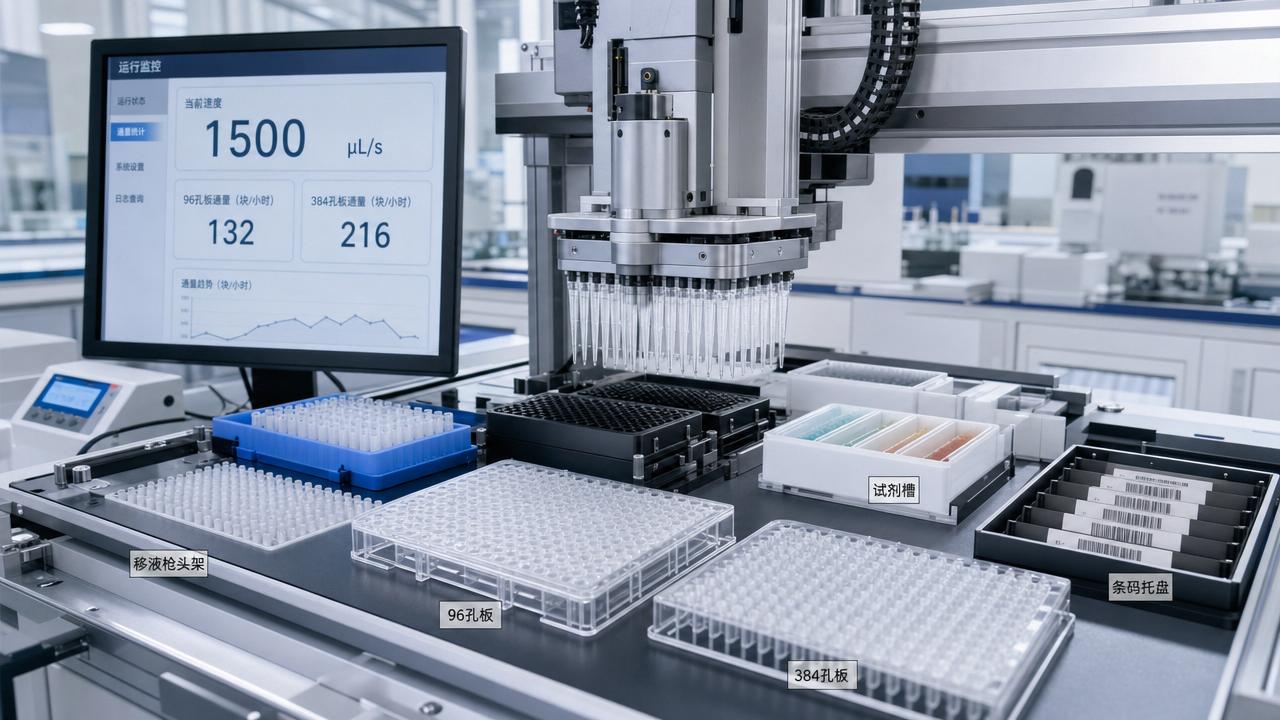
Plate format is one of the most obvious yet frequently overlooked variables. Processing a 96-well plate is not equivalent to processing a 384-well or 1536-well plate. Even when a vendor normalizes data to time per plate, differences in well density, approach path, aspiration pattern, and liquid settling can change the true operational burden. A fast result on one format should never be assumed to scale linearly to another.
Liquid class has an even greater effect. Water-like fluids are easier to handle than viscous buffers, serum-containing media, solvents, suspensions, or temperature-sensitive reagents. Systems often require slower aspiration, modified dispense profiles, pre-wetting, blowout adjustments, or longer settle times for difficult liquids. If microplate processing time data is generated with easy fluids, it may significantly understate the cycle time of actual production-relevant applications.
Volume range also matters. Dispensing at 100 microliters is not operationally equivalent to dispensing at 1 microliter or below. At lower volumes, motion and timing tolerances become tighter, and maintaining precision often requires speed tradeoffs. For fluidic-precision workflows, especially where sub-microliter consistency affects assay outcomes, throughput claims must be reviewed alongside coefficient of variation and bias data.
Tip strategy can distort comparisons as well. Reusable tips, disposable tips, filtered tips, wash cycles, and tip change frequency each alter the total cycle. A published result that excludes tip loading or wash steps may not reflect contamination-sensitive workflows. In regulated environments, carryover prevention can be more decisive than peak motion speed, making tip management a major hidden factor in real throughput.
Deck layout and travel distance are another source of timing inflation. Motion paths depend on where plates, reservoirs, tip racks, and waste positions are located. A benchmark using a simplified deck may minimize movement overhead in ways that a production-oriented layout cannot. Once accessories and safety clearances are added, the original timing claim may no longer hold.
Dead volume and refill behavior are particularly important in cost-sensitive or precious-reagent workflows. Processing time can appear favorable when the system uses large source volumes that reduce refill frequency. In practice, minimizing dead volume may require different containers, slower aspiration settings, or more complex liquid-level detection. The time penalty may be worth it, but it must be visible during evaluation.
Software and control logic can introduce less visible delays. Some systems execute elegant movement sequences in demonstrations but accumulate pauses during error checks, user confirmations, plate identification, or communication with peripheral devices. These delays are operationally real. If they occur on every plate, they can materially reduce hourly throughput even though the core dispense motion remains fast.
Why isolated timing data is weaker than workflow-level throughput analysis
A plate-processing number is often too narrow to support capital decisions. What matters in practice is workflow throughput: the amount of compliant, usable output generated per hour or per shift under representative conditions. This includes upstream and downstream dependencies such as plate loading, barcode scanning, environmental equilibration, shaking, sealing, reading, unloading, and exception handling.
Technical evaluators should therefore move from component timing to system timing. A liquid handler may process one step quickly, but if the next station becomes the bottleneck, overall line performance will not improve. In integrated settings, the slowest stable step sets the true pace. This is especially important in batch-to-continuous transitions, where localized speed gains can be cancelled by synchronization losses elsewhere in the architecture.
Another reason workflow-level analysis matters is utilization. Some systems show excellent short-cycle performance but require frequent operator intervention, maintenance pauses, or consumable replenishment. Effective throughput drops when the platform cannot sustain unattended operation. A realistic evaluation should consider not just seconds per plate, but plates per hour over a full duty period with standard supervision.
For high-value organizations, this distinction affects return on investment. Capital purchases based on optimistic microplate processing time data may fail to deliver expected capacity gains once deployed. A more rigorous workflow view helps procurement and engineering teams align performance claims with labor assumptions, batch scheduling, and validation commitments.
How to read vendor timing claims without over-trusting them
The first step is to ask exactly what start and stop points were used. Did timing begin after the plate was already in position? Did it end before mixing, sealing, tip disposal, or verification? Without these boundaries, the figure is not auditable. A credible benchmark should define every included and excluded action clearly.
Next, ask what materials and settings were used. The liquid type, viscosity range, temperature, source container geometry, aspiration depth control, dispense mode, and plate type should all be documented. If these parameters are unavailable, the data is better treated as illustrative rather than decision-grade.
It is also important to request paired quality data. A timing result means little without corresponding precision, accuracy, carryover, and failure-rate information. If a system is faster only because it runs more aggressively, the resulting errors or rework may erase the speed advantage. For technical evaluators, timing must be interpreted together with fluidic performance.
Another useful practice is to compare best-case, nominal, and stress-case timings. Best-case testing shows the upper performance boundary. Nominal testing reflects routine conditions. Stress-case testing reveals how the platform behaves with challenging liquids, long sequences, or dense deck configurations. The spread between these cases often says more about system robustness than the headline number itself.
A practical evaluation framework for more trustworthy comparisons
To make microplate processing time data genuinely useful, evaluators should create a comparison matrix based on application-relevant scenarios. Instead of asking which machine is fastest in general, ask which machine performs best for the exact plate types, volume ranges, liquid classes, contamination controls, and integration requirements that matter most to your site.
A strong protocol usually includes at least three test modes. The first is a baseline run using a simple liquid and standard plate. The second is a representative run using the actual or closest available process fluid. The third is a boundary run using the most difficult expected condition, such as low-volume dispensing, high viscosity, fragile cells, or minimal dead-volume sourcing. This structure reveals whether the system’s speed advantage survives realistic complexity.
Evaluators should also measure sustained throughput across a longer interval, not only single-cycle performance. Multi-hour or multi-shift tests often expose drift, consumable handling inefficiencies, or software slowdowns that short demonstrations miss. In many cases, the most decision-relevant number is not the fastest plate time, but the average validated output over a realistic operating window.
Where possible, include integration conditions in the test. If the unit will operate with stackers, readers, incubators, or manufacturing execution systems, benchmark it in that context. Standalone timing data can be directionally useful, but integrated timing data is far more predictive of deployment reality.
Finally, translate the findings into business terms. Quantify the cost of reagent loss from dead volume, the labor effect of operator touchpoints, the scheduling impact of cycle variability, and the quality risk associated with aggressive timing settings. For procurement officers and engineering leads, this turns abstract speed claims into decision-grade evidence.
When faster processing time is genuinely meaningful
None of this means speed data is useless. Faster microplate processing time data is meaningful when it is transparently generated, paired with quality metrics, and validated under relevant operating conditions. In that context, it can help estimate capacity, identify bottlenecks, and compare automation strategies.
It is particularly valuable when differences remain consistent across representative liquids, plate formats, and integrated workflows. If one platform delivers shorter cycle times without sacrificing precision, contamination control, or uptime, that advantage is real. The key is that the data must describe a repeatable operational state, not a favorable demonstration snapshot.
For organizations focused on micro-efficiency, the strongest indicator is not isolated speed but balanced performance: high throughput with controlled variability, low dead volume, stable fluidic behavior, and compatibility with validation and scale-up requirements. That is the level at which timing data becomes strategically useful.
Conclusion: evaluate the architecture behind the number
Microplate processing time data can be misleading because it often compresses a complex workflow into a single attractive figure. For technical evaluators, the risk is not misunderstanding a number in theory; it is making a procurement or process decision based on conditions that do not match reality. Plate format, liquid behavior, volume, tip strategy, software logic, deck design, and integration context all shape what that number actually means.
The most effective response is to evaluate timing data as part of a broader architecture of performance. Ask what was measured, what was omitted, what quality was maintained, and whether the result survives realistic workflow conditions. When those questions are answered rigorously, speed claims become more than marketing language. They become useful evidence for selecting fluidically precise, operationally dependable systems.
In short, the right question is not “How fast is this microplate system?” but “How fast is it when doing my work, at my quality standard, in my operating environment?” That is the question that leads to better benchmarking, lower implementation risk, and smarter equipment decisions.
Expert Insights

Chief Security Architect
Dr. Thorne specializes in the intersection of structural engineering and digital resilience. He has advised three G7 governments on industrial infrastructure security.
Related Analysis
Core Sector // 01
Security & Safety
- Testing Dilution Factor Precision and Repeatability in Automated Liquid HandlingAuthor :Lina Cloud

- How to Assess a European Liquid Handling Software Supplier for Lab AutomationAuthor :Lina Cloud

- Pipette Tip Fit for Automation: Checking Deck, Gripper, and Seal CompatibilityAuthor :Lina Cloud

- How to Evaluate an Automated Sample Dilutor Factory for Traceable Lab WorkflowsAuthor :Lina Cloud

- What Drives Liquid Handling Software Costs in Automated Laboratory Workflows?Author :Lina Cloud

- What to Verify in Validated Liquid Handling Software for GxP WorkflowsAuthor :Lina Cloud

- Selecting Automated Liquid Handling Systems for High-Throughput AssaysAuthor :Lina Cloud

- How to Validate Lab Automation Standards for Reliable, Compliant WorkflowsAuthor :Lina Cloud