What Causes Peristaltic Pump Flow Rate Stability to Drift
Author
Date Published
Reading Time
When peristaltic pump flow rate stability begins to drift, even a well-calibrated system can compromise dosing accuracy, product consistency, and downstream process control. For after-sales maintenance teams, identifying the real causes behind unstable output is essential to reducing downtime and protecting fluidic precision. This article outlines the most common factors that affect peristaltic pump flow rate stability and how to address them effectively.
Why does peristaltic pump flow rate stability matter so much in maintenance work?
Peristaltic pump flow rate stability is not only a performance metric; it is a practical indicator of whether a dosing system is still operating within expected process limits. In lab-scale production, pilot synthesis, bioprocessing, liquid handling, and precision transfer applications, even a small fluctuation can distort feed ratios, residence time, sampling consistency, or reagent addition profiles. For after-sales maintenance personnel, this makes flow drift a service issue with direct operational and regulatory consequences.
Unlike some pumping technologies that rely on valves or rigid displacement chambers, a peristaltic pump depends on repeated compression and recovery of flexible tubing. That design offers contamination control and easy fluid isolation, but it also means the actual output is highly sensitive to tubing condition, rotor mechanics, installation quality, and fluid properties. When customers report unstable flow, the problem is rarely caused by one variable alone. In many cases, peristaltic pump flow rate stability declines gradually due to the interaction of wear, operating habits, and process conditions.
This is why maintenance teams should treat flow instability as a system-level diagnostic question rather than a simple calibration problem. Looking only at motor speed or replacing one part without root-cause analysis often leads to repeated service calls.
What are the most common mechanical reasons for flow rate drift?
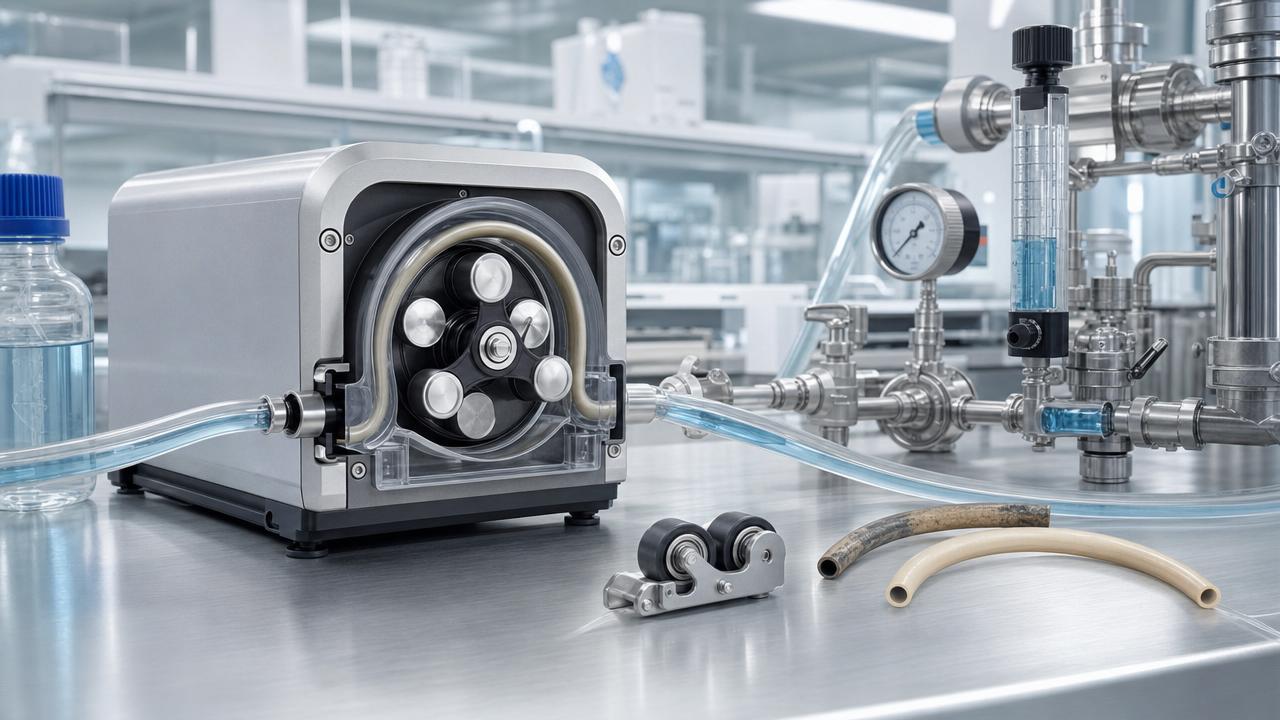
Mechanical causes are among the most frequent reasons peristaltic pump flow rate stability begins to drift. The first and most obvious suspect is tubing fatigue. Over time, repeated occlusion causes the tube wall to lose elasticity, reducing its ability to rebound uniformly after roller compression. Once the tubing recovery profile changes, each rotation delivers a slightly different volume, and pulsation may increase.
Rotor and roller wear is another major factor. If rollers no longer rotate smoothly, if bearings develop resistance, or if the rotor path is no longer perfectly even, compression can become inconsistent across the tube length. That inconsistency translates into unstable displacement per cycle. In higher-duty laboratory and pilot systems, even minor mechanical wear can accumulate into a measurable drop in peristaltic pump flow rate stability.
Pump head alignment also deserves attention. A poorly seated pump head, worn track, or uneven occlusion setting may cause one section of tubing to be compressed more than another. This leads to cyclic output variation and, in severe cases, backflow or slip. Maintenance personnel should also inspect shaft coupling, drive train vibration, and mounting integrity. If the drive is mechanically sound but the pump head shifts under load, the delivered flow can drift even while the displayed RPM remains constant.
A practical rule is simple: if the pump sounds different, feels hotter, vibrates more, or shows visible tubing flattening, mechanical deterioration is already affecting output quality.
How much does tubing selection affect peristaltic pump flow rate stability?
Tubing selection has a larger impact on peristaltic pump flow rate stability than many users expect. The tube is the fluid path and the metering element at the same time, so any mismatch in material, wall thickness, hardness, or internal diameter directly changes flow behavior. If the tubing is too soft, it may over-compress and wear quickly. If it is too hard, it may resist full occlusion or recover poorly, causing under-delivery and instability.
Material compatibility also matters. Certain solvents, buffers, cell culture media additives, or cleaning agents can swell, stiffen, or embrittle tubing. The result is not always immediate leakage. More often, the first symptom is gradual drift in peristaltic pump flow rate stability. In regulated or precision environments, using a visually acceptable but chemically stressed tube can create a hidden accuracy problem long before operators notice obvious failure.
Installation quality is equally important. If the tubing is stretched during fitting, twisted in the pump head, or not seated according to the intended track geometry, the effective flow per revolution changes. After-sales teams should verify not just the part number, but also the installation method, tubing lot consistency, and replacement interval. In many service cases, “same specification” tubing from different suppliers does not behave identically under compression.
Quick troubleshooting table for common drift symptoms
The table below helps maintenance teams connect field symptoms with likely causes affecting peristaltic pump flow rate stability.
Can fluid properties and operating conditions really cause output instability?
Yes, and this is one of the most underestimated reasons peristaltic pump flow rate stability changes in the field. A pump may perform well during water-based commissioning but drift significantly when processing real media, solvents, slurries, viscous intermediates, or temperature-sensitive formulations. Viscosity alters how easily the tube fills and empties during each cycle. Higher viscosity can increase suction losses and back pressure, while lower viscosity can exaggerate pulsation effects in lightweight tubing assemblies.
Temperature is another strong variable. Flexible tubing becomes softer at higher temperatures and stiffer at lower temperatures. That means the same occlusion setting may not produce the same output across different operating windows. In pharmaceutical, chemical, and laboratory environments where cleaning cycles, ambient conditions, and fluid temperatures vary, peristaltic pump flow rate stability should be evaluated under actual process conditions, not only under room-temperature test conditions.
Gas bubbles or poor suction conditions can further destabilize delivery. If the inlet line draws intermittent air because of loose fittings, excessive suction lift, or degassing fluid, the pump no longer moves a fully filled liquid segment on every rotation. This often appears as random flow fluctuation, but the root cause is hydraulic rather than purely mechanical. Maintenance teams should therefore inspect inlet immersion depth, fitting integrity, filter blockage, and fluid reservoir behavior before replacing components unnecessarily.
How do motor control, calibration, and sensors influence flow rate stability?
Peristaltic pump flow rate stability depends on more than tubing and rollers. The drive system must maintain consistent speed under changing load. If the motor controller cannot compensate for torque variation, or if encoder feedback is degraded, RPM may drift slightly during operation. Those small speed deviations become larger dosing errors in low-flow or long-duration applications.
Calibration errors can also mislead maintenance teams. A pump may appear unstable when the actual issue is that its calibration factor was established using a different fluid, different tubing age, or different back-pressure condition. In precision environments, one-point calibration is often insufficient. When possible, calibration should reflect the real operating range and process fluid characteristics. This is especially relevant for organizations focused on bench-to-pilot reproducibility and micro-efficiency, where benchmark performance must hold under realistic conditions.
If the system includes flow sensors, pressure sensors, or integrated control software, signal quality must also be checked. Electrical noise, sensor fouling, response lag, and incorrect scaling can create the impression of unstable output even when the pump is mechanically stable. After-sales teams should separate true hydraulic drift from instrumentation drift by using a controlled verification method such as timed gravimetric testing.
What maintenance mistakes most often reduce peristaltic pump flow rate stability?
The most common mistake is replacing tubing too late. Many sites wait for rupture, leakage, or visible flattening before intervention, but by that stage peristaltic pump flow rate stability has usually been declining for some time. A preventive replacement schedule based on run hours, duty cycle, and fluid exposure is far more effective than reactive replacement.
Another frequent mistake is treating all tubing changes as equivalent. If technicians do not document tubing material, lot, installation orientation, and calibration updates, recurring instability becomes difficult to trace. In B2B laboratory and pilot environments, maintenance quality depends heavily on standardization. The more precise the process, the more disciplined the service record must be.
Improper cleaning practices also contribute to drift. Aggressive sanitizers, unsuitable solvents, and excessive thermal exposure can shorten tube life and damage pump head components. Similarly, over-tightening fittings on the suction or discharge side may create unnecessary restriction or intermittent air ingress. Some teams also overlook the effect of idle compression: leaving tubing clamped in the same occluded position for long shutdown periods can permanently deform the tube and reduce startup accuracy.
A stronger maintenance routine usually includes four elements: scheduled inspection, verified replacement parts, process-specific calibration, and post-service flow confirmation under real-use conditions.
How can after-sales teams diagnose drift faster and prevent repeat service calls?
A fast diagnosis starts with a structured sequence. First, confirm whether the problem is true flow instability, average flow loss, or measurement inconsistency. Second, compare current operating conditions with the original validated state: tubing type, fluid, temperature, back pressure, and run speed. Third, inspect tubing and pump head together instead of evaluating them separately. Fourth, verify actual output using a gravimetric or volumetric test over a meaningful time interval.
To reduce repeat issues, maintenance teams should create drift signatures. For example, a slow daily drop may point to tubing relaxation, while a repeating oscillation may indicate roller or occlusion problems. A problem that appears only on viscous media likely suggests hydraulic loading or suction deficiency. Capturing these patterns helps teams shorten troubleshooting time across similar installed units.
It is also useful to separate customer-process variables from pump-platform variables. In multidisciplinary settings such as pilot-scale reactors, microfluidic dosing, cell culture feed systems, centrifugation support lines, and automated liquid handling, the same pump technology may behave differently because the surrounding process architecture changes. Effective service therefore requires both hardware knowledge and application awareness.
What questions should be asked before recommending a fix, replacement, or system upgrade?
Before proposing corrective action, after-sales personnel should clarify a few essential points. Has the decline in peristaltic pump flow rate stability been sudden or gradual? Does it occur with one fluid or all fluids? Was the tubing changed recently, and if so, was recalibration performed? Is the pump operating under the same pressure, temperature, and duty cycle as before? Are there signs of air ingress, pulsation sensitivity, or process-side restrictions?
These questions help determine whether the right solution is a tubing change, pump head rebuild, controller check, sensor verification, or application-specific redesign. In some cases, the installed pump is still suitable, but the process has evolved beyond the original specification. In others, repeated drift may justify moving to a configuration with better tubing life, closed-loop control, or improved compatibility with sensitive formulations.
If further confirmation is needed on a specific maintenance plan, performance benchmark, qualification path, service interval, or replacement strategy, it is best to first communicate the fluid type, target flow range, runtime profile, tubing specification, measured deviation, and the exact conditions under which peristaltic pump flow rate stability begins to drift. Those details make troubleshooting faster, recommendations more accurate, and long-term reliability easier to protect.
Expert Insights

Chief Security Architect
Dr. Thorne specializes in the intersection of structural engineering and digital resilience. He has advised three G7 governments on industrial infrastructure security.
Related Analysis
Core Sector // 01
Security & Safety
- Precision Dispenser Pricing: Cost Drivers and Budgeting for Lab AutomationAuthor :Dr. Aris Nano

- China Tightens Export Compliance Checks on Lab Fluid-Control DevicesAuthor :Dr. Aris Nano

- China Tightens Export Checks on Lab Fluid DevicesAuthor :Dr. Aris Nano

- China Customs Tightens Export Checks for Lab Liquid-Handling EquipmentAuthor :Dr. Aris Nano

- ECHA SVHC Update Reaches Precision Fluid DevicesAuthor :Dr. Aris Nano

- FDA Tightens Accuracy Rule for Lab Fluid DevicesAuthor :Dr. Aris Nano

- ECHA Adds 12 SVHCs Affecting Lab Fluid DevicesAuthor :Dr. Aris Nano

- How to Choose a Variable Speed Peristaltic Pump for Accurate Lab Fluid TransferAuthor :Dr. Aris Nano